The big picture
Place colonial growth within continuing Indigenous sovereignty, competing European empires, distinct English regions, Atlantic commerce and slavery, and developing political and religious cultures.
Exam focus 01
Contextualizing Period 2 means explaining the systems surrounding colonial growth
APUSH Period 2 runs from the founding of Jamestown in 1607 to the opening of the French and Indian War in 1754. Topic 2.1 asks for the broader setting in which European colonies expanded. That setting includes Indigenous nations that remained sovereign political actors, several competing European empires, the development of distinct English colonial regions, expanding Atlantic commerce and slavery, and colonial political and religious institutions that became more established over time.
A useful contextualization argument begins before the event named in a prompt. For early English settlement, explain how Period 1 created an Atlantic world through sustained voyages, epidemic exchange, Spanish conquest, coerced labor, and imperial rivalry. Then connect that context to a Period 2 development: English joint-stock settlement, tobacco production, Native diplomacy and warfare, the growth of slavery, or regional political institutions.
Do not turn context into a miniature textbook chapter. Select a broader development relevant to the prompt, name one or two specific pieces of evidence, and state why that background made the later development more likely or historically significant.
Transition 02
Period 2 extended the Atlantic transformations of Period 1 but shifted toward permanent colonial societies
Before 1607, Spanish conquest and colonization had already connected American land, Indigenous labor, African forced migration, European capital, and global trade. Epidemic disease devastated many Native communities, but did not eliminate Indigenous political authority. European powers had learned that American ventures required state backing, private investment, reliable resupply, and relationships—cooperative or violent—with the peoples whose homelands they entered.
Jamestown marked a turning point because it became a permanent English foothold within the Powhatan political world. Quebec followed in 1608 as a French center in the St. Lawrence Valley. Dutch New Netherland, English New England, Caribbean plantation colonies, and Spanish borderlands created overlapping zones of commerce, migration, missionization, warfare, and diplomacy. Colonies that survived developed towns, farms, plantations, churches, assemblies, courts, and increasingly unequal labor systems.
Important continuities remained. Europeans still sought wealth, strategic advantage, land, and Christian expansion. Indigenous nations continued to trade, negotiate, form alliances, relocate, and resist. Coerced labor remained central, while African slavery expanded dramatically and became more closely tied to inherited racial status in English colonies during the late seventeenth and early eighteenth centuries.
Continuity
Imperial rivalry, Native sovereignty, Atlantic commerce, religious goals, epidemic effects, and labor coercion continued from Period 1.
Change
Permanent settlements, settler population growth, regional colonial economies, elected assemblies, and racialized chattel slavery became more established.
Turning point
1607 matters because English activity shifted from failed or temporary ventures toward a lasting settler colony with expanding land and labor demands.
Indigenous context 03
Native nations remained essential powers in a continent of contested borderlands
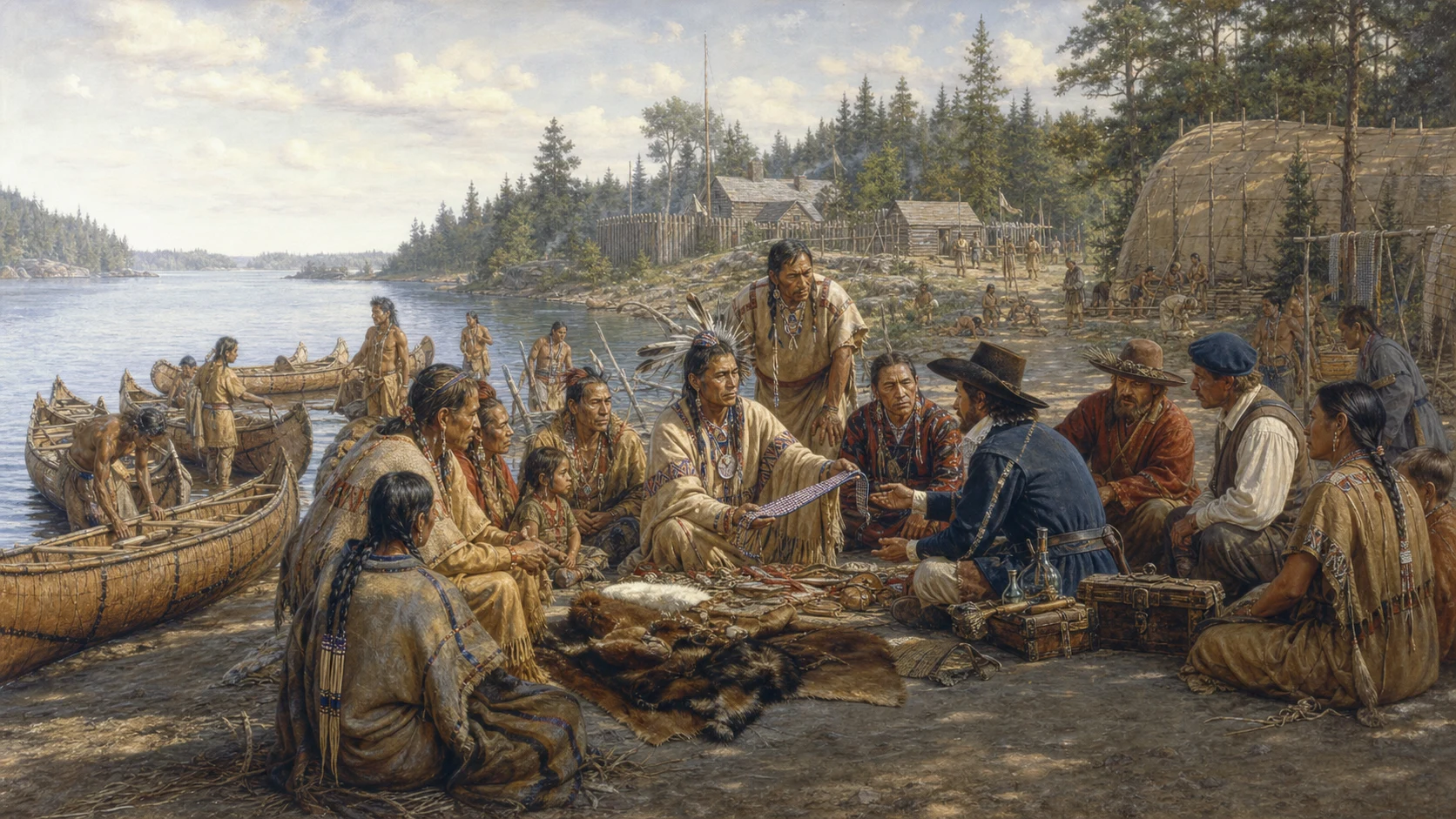
European maps claimed enormous territories, but control on the ground remained limited and negotiated. The Powhatan political network initially supplied and bargained with Jamestown while seeking to manage the settlement. Haudenosaunee leaders used diplomacy and warfare to pursue strategic influence in the Northeast and Great Lakes. Pueblo communities drove Spanish colonists from New Mexico during the Pueblo Revolt of 1680 and preserved independence until Spain returned in the 1690s under a modified colonial arrangement.
The fur trade encouraged French and Dutch traders to build alliances and travel through Native exchange networks. European partners depended on Indigenous geographic knowledge, food production, transport, diplomacy, and military support. Native nations adopted selected goods such as metal tools, cloth, firearms, and horses while preserving political and cultural priorities. Trade could increase wealth and leverage, but it could also intensify warfare, debt, hunting pressure, disease transmission, and dependence on imported goods.
Settler expansion produced severe conflicts over land and authority. The Pequot War and King Philip's War devastated Native communities in New England, while also imposing heavy costs on colonists. These wars did not prove the immediate disappearance of Indigenous power. Beyond densely settled areas, Native nations continued to control territory and force empires to negotiate through the middle of the eighteenth century and beyond.
Imperial comparison 04
European empires pursued different colonial strategies, but every strategy depended on Native and African labor or cooperation
Spain, France, the Netherlands, and England entered North America with different population levels, economic priorities, religious institutions, and methods of rule. Those differences shaped settlement density and patterns of interaction, but no empire followed a single unchanging model. Local geography, Native power, settler demands, metropolitan policy, and warfare continually altered colonial practice.
For exam comparison, identify a common goal—wealth, strategic advantage, conversion, or land—and then explain how each empire pursued it differently. Avoid claiming that French relations were always peaceful or that English colonists never traded with Native nations. Relative settler population, dependence on alliances, and demand for land help explain broad patterns without erasing local variation.
| Empire | Major goals and settlements | Typical economic pattern | Relations and limits |
|---|---|---|---|
| Spanish | Defend older claims, extend missions and settlements in Florida, New Mexico, Texas, and California's later frontier | Missions, ranching, agriculture, tribute, mining elsewhere in Spanish America, and coerced Indigenous or African labor | Missionization and labor demands produced accommodation and resistance; the 1680 Pueblo Revolt temporarily expelled Spain from New Mexico |
| French | Control the St. Lawrence, Great Lakes, Mississippi Valley, and strategic links between Canada and Louisiana | Fur trade, fisheries, mission activity, and relatively dispersed settlement | Small settler populations increased dependence on Native trade and military alliances, though relations still included coercion and conflict |
| Dutch | Build a commercial colony around the Hudson River and New Amsterdam | Fur trade, shipping, finance, and Atlantic commerce | Commercial pluralism coexisted with land conflict and slavery; England seized New Netherland in 1664 |
| English/British | Create settler colonies along the Atlantic coast and Caribbean plantation colonies | Family farming, shipping, commerce, tobacco, rice, indigo, and plantation production depending on region | Large settler migration increased pressure for Native land; colonies used both alliance and warfare while expanding indentured and enslaved labor |
Regional development 05
Environment, migration, labor, and settlement goals produced four distinct English colonial regions
English colonies shared allegiance to the Crown and participated in Atlantic commerce, but they did not form one uniform society. Climate and soil influenced staple crops; the origins and goals of migrants shaped religion and community organization; and access to labor and markets affected wealth and inequality. Regional comparison is therefore more useful than a generic description of ‘the colonies.’
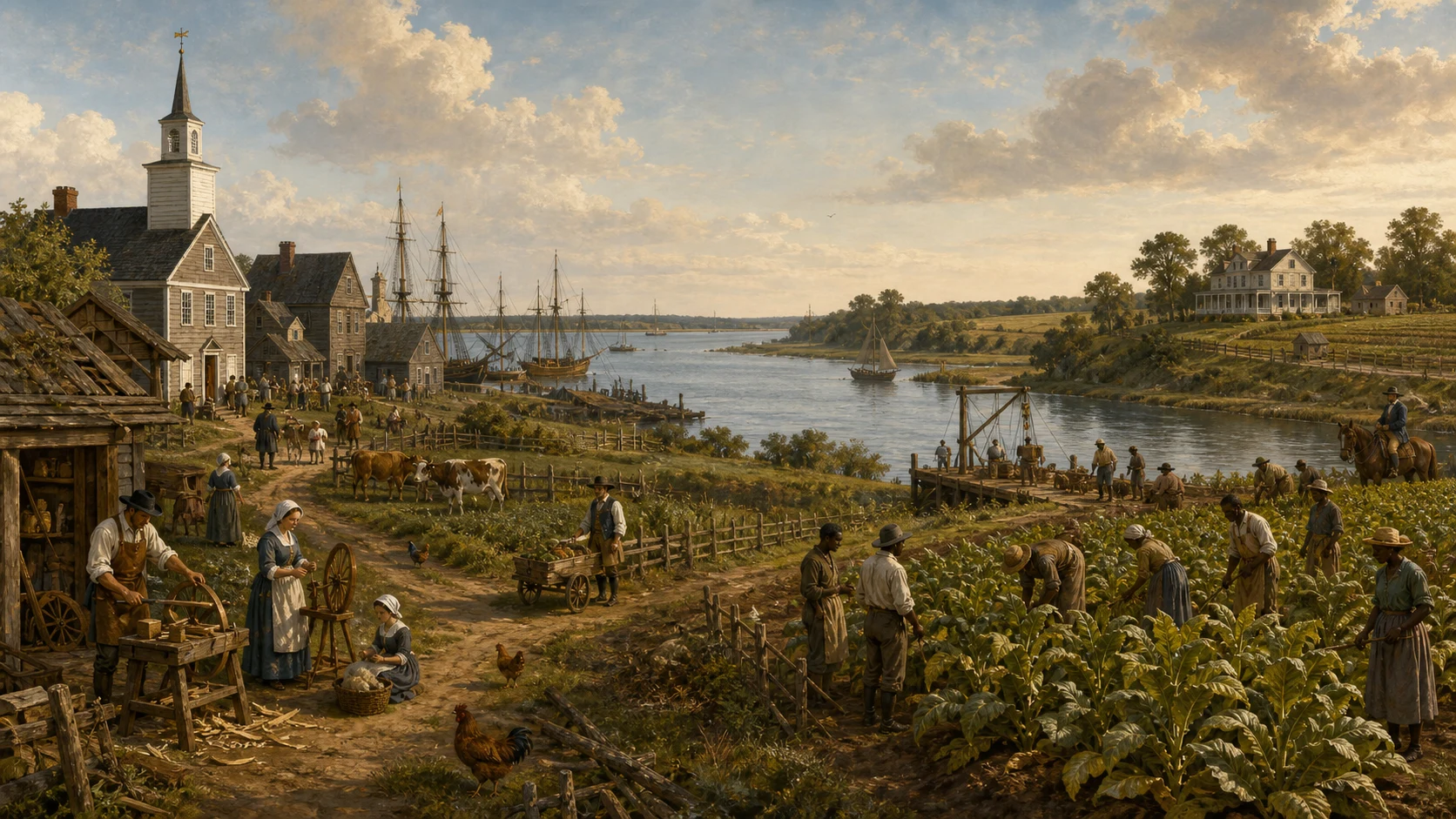
New England towns often grew around congregations and mixed family farms, while the Chesapeake developed dispersed tobacco plantations and a heavily male early population. The Middle Colonies combined grain exports, port commerce, ethnic and religious diversity, and both family and bound labor. The Lower South used plantation production of rice and indigo, with enslaved Africans and African knowledge central to economic growth.
| Region | Settlement and society | Economy | Labor and political pattern |
|---|---|---|---|
| New England | Compact towns, family migration, Puritan influence, relatively balanced sex ratio, high literacy | Mixed farming, fishing, timber, shipbuilding, commerce, and Atlantic trade | Family labor, servants, and slavery; town meetings and congregational communities, with political participation restricted |
| Middle Colonies | Ethnically and religiously diverse cities and countryside, including Quakers, Dutch, Germans, and others | Grain exports, livestock, artisan production, shipping, and port commerce | Family, tenant, indentured, and enslaved labor; elected assemblies alongside proprietary or royal authority |
| Chesapeake | Dispersed plantations, Anglican establishment, initially unstable families and high mortality that later moderated | Tobacco as the dominant export crop | Indentured servitude remained important before slavery expanded; county government and planter-dominated assemblies |
| Lower South | Dispersed plantations and port towns with strong Caribbean connections | Rice and indigo exports, deerskin trade, and Atlantic commerce | Enslaved Africans became a large share or majority in some areas; wealthy planters dominated politics while African expertise shaped production |
Economy and labor 06
Atlantic commerce enriched colonial societies while expanding bound labor and racial slavery
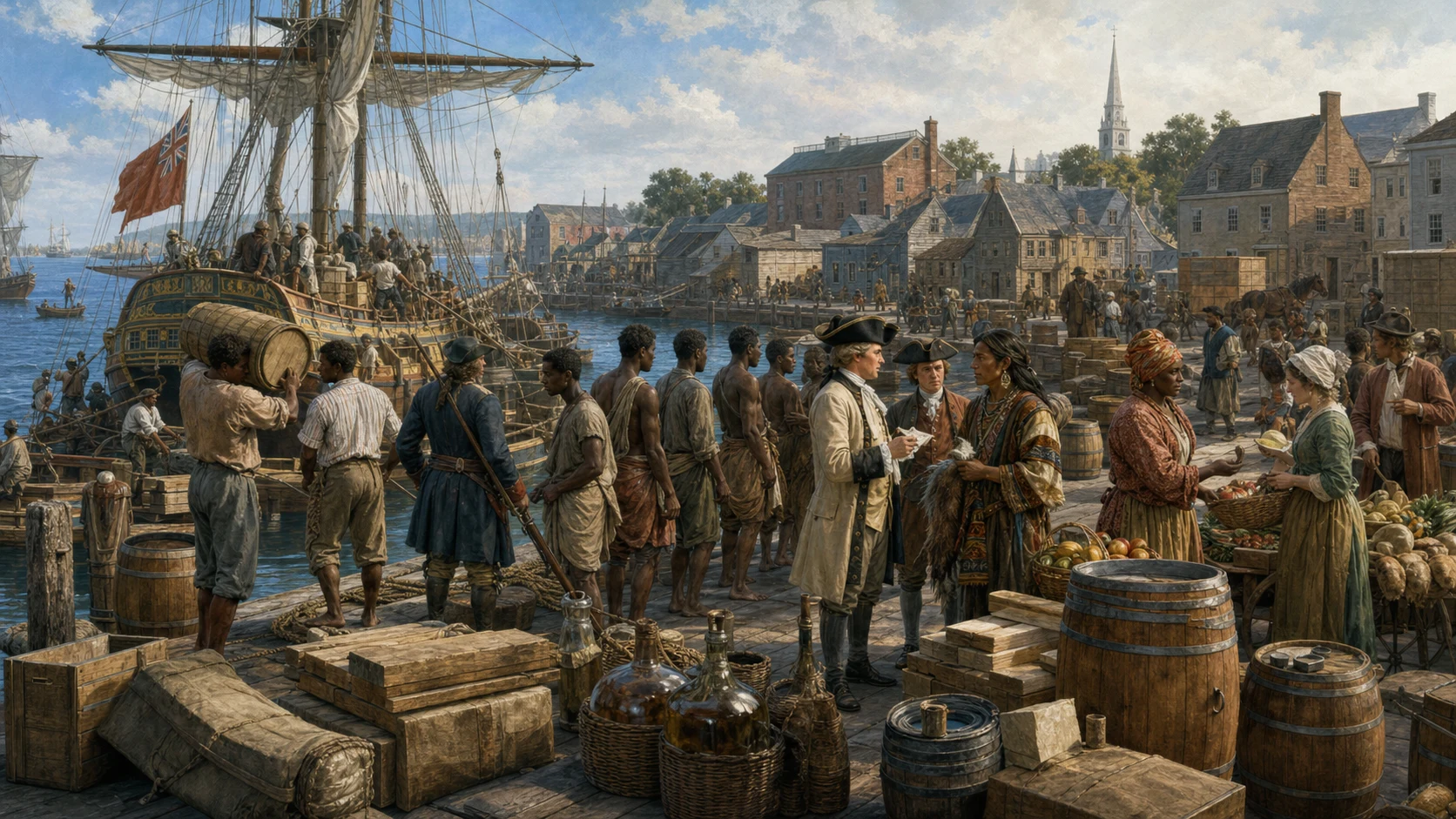
British mercantilist policy treated colonies as sources of raw materials, markets for manufactured goods, and components of imperial power. Navigation Acts directed important trade through English or colonial ships and ports. In practice, merchants also smuggled, traded within the Caribbean, and connected colonial economies to Africa and continental Europe. The Atlantic economy was a network rather than a simple triangle, and different commodities followed different routes.
Indentured servants supplied much of the Chesapeake's early English workforce. In exchange for passage, servants owed several years of labor and faced harsh discipline, but their legal status and fixed term distinguished servitude from hereditary chattel slavery. As tobacco and rice expanded, the supply and cost of servants changed, elite fears of landless former servants grew, and Atlantic slave trading became more developed. Colonial lawmakers increasingly tied African ancestry to lifelong, inheritable enslavement.
Bacon's Rebellion in 1676 exposed conflict over Native land, frontier security, political access, taxes, and elite power. The rebellion contributed to planter interest in a workforce that colonial law made permanent and racially divided, but it did not single-handedly cause slavery. Profit, plantation demand, existing racial ideas, imperial trade, demographic change, and legislation all contributed. Enslaved Africans resisted through family and community formation, cultural preservation, negotiation, work resistance, escape, and revolt, including the Stono Rebellion of 1739.
Mercantilism
The empire sought to channel trade and resources toward national wealth and power; colonists could benefit from protected markets while resisting regulation.
Indentured servitude
A time-limited labor contract, usually exchanged for Atlantic passage, that remained coercive but was not legally hereditary chattel slavery.
Racial slavery
Colonial statutes increasingly made enslavement lifelong and inheritable while restricting the rights of Africans and their descendants.
African agency
Africans brought agricultural, craft, commercial, linguistic, and religious knowledge and created communities while resisting enslavement under severe constraints.
Institutions and ideas 07
Colonial self-government, religious diversity, revival, and print culture developed inside an unequal empire
Representative institutions appeared early: Virginia's House of Burgesses met in 1619, and New England towns used local meetings. Colonial assemblies gained influence over taxation, spending, and local law, especially during periods of loose imperial supervision often described as salutary neglect. Yet participation was limited by property, gender, race, legal status, and religion. Colonial government combined local experience with governors, proprietors, and imperial authority rather than creating democracy in a modern sense.
Religion shaped settlement and public life. Puritans sought a covenanted society in Massachusetts Bay but punished or expelled dissenters such as Roger Williams and Anne Hutchinson. Pennsylvania offered comparatively broad toleration under Quaker influence, while Maryland's 1649 toleration law protected many Christians but not unrestricted religious freedom. Established churches and local religious diversity coexisted across the colonies.
The First Great Awakening of the 1730s and 1740s emphasized personal conversion and emotional preaching. It divided congregations between supporters and critics of revival and allowed itinerant ministers to reach people across colony lines. Enlightenment ideas emphasized reason, natural law, and empirical inquiry. Neither movement directly caused independence, but both broadened debate about authority and helped create shared intercolonial conversations later used in political conflict.
Exam method 08
Choose context that matches the prompt, then make the connection explicit
For a prompt about regional development, begin with the varied goals of migrants, environmental conditions, and the Atlantic demand for staple crops. For a prompt about slavery, begin with earlier Spanish and Portuguese Atlantic trafficking, colonial labor demand, and the initial importance of indentured servitude. For a prompt about Native–European relations, begin with preexisting Native sovereignty and the imperial competition that made alliances valuable.
A complete contextualization paragraph usually needs three moves: identify a broad development before or around the prompt's period, provide specific evidence, and explain the relationship to the thesis. Context earns value through relevance. The Columbian Exchange may be useful for a colonial labor prompt because demographic change and Atlantic connections reshaped labor demand; it is less useful if merely listed without that link.
On an SAQ, one concise context sentence may support the answer even when contextualization is not a separate point. In an LEQ or DBQ, build a focused opening paragraph and then use the thesis to transition into the argument. Do not use present-day comparisons or evidence outside the requested dates unless it genuinely clarifies a broader process.
Prompt: regional colonies
Use environment, migration goals, staple-crop demand, and settlement patterns as context.
Prompt: slavery
Use Atlantic trafficking, labor demand, indentured servitude, plantation expansion, and racial law as context.
Prompt: Native relations
Use Indigenous sovereignty, European rivalry, trade networks, land pressure, and demographic disruption as context.
Prompt: colonial politics
Use charters, corporate or proprietary settlement, local institutions, distance from Britain, and uneven imperial supervision as context.
High-yield review
Key developments
Permanent colonies expanded
English Jamestown, French Quebec, Dutch New Netherland, Spanish borderlands, and later English colonies created durable but contested imperial footholds.
Native sovereignty shaped imperial outcomes
Indigenous nations controlled territory, trade, knowledge, diplomacy, and military power and used alliances or resistance to pursue their own goals.
Distinct colonial regions developed
Environment, staple crops, migrant goals, family patterns, labor systems, and Atlantic connections differentiated New England, Middle, Chesapeake, and Lower South colonies.
Atlantic commerce and slavery expanded together
Mercantilism, plantation exports, shipping, consumer goods, indentured labor, and an expanding slave trade connected colonial prosperity to coercion and racial hierarchy.
Colonial political institutions gained experience
Assemblies, town meetings, courts, and local taxation operated within corporate, proprietary, royal, and imperial systems while political participation remained restricted.
Religious and intellectual life diversified
Established churches, dissent, toleration experiments, print culture, the Great Awakening, and Enlightenment ideas created overlapping debates about belief and authority.
Chronological reasoning
Timeline — key moments
Jamestown becomes a permanent English foothold
The Virginia Company settlement enters the Powhatan political world and begins sustained English colonization in the Chesapeake.
Quebec anchors New France
Samuel de Champlain establishes a French center on the St. Lawrence that depends heavily on trade and alliances with Native nations.
Assembly and forced African arrival mark Virginia's growth
The House of Burgesses meets, while captive Africans arrive in Virginia within an evolving labor system that later hardens into racial slavery.
Plymouth Colony founded
Separatist migrants establish a settlement in Wampanoag homelands and depend on Native knowledge and diplomacy for survival.
Massachusetts Bay migration expands
Puritan families create towns and congregations during a larger migration that makes New England settlement more populous and permanent.
Pequot War transforms southern New England
English settlers and Native allies defeat the Pequot in a brutal conflict over trade, territory, and regional power.
Maryland Toleration Act adopted
The law protects Trinitarian Christians amid Catholic–Protestant tension but does not create universal religious freedom.
England seizes New Netherland
New Amsterdam becomes New York, demonstrating imperial rivalry and placing a diverse commercial colony under English control.
King Philip's War and Bacon's Rebellion expose conflict
War devastates New England communities, while rebellion in Virginia reveals tensions over land, Native policy, inequality, and political power.
Pueblo Revolt expels Spanish colonists
Pueblo communities coordinate resistance to missionization, labor demands, and colonial rule and preserve independence for more than a decade.
Pennsylvania chartered
William Penn's Quaker-influenced colony attracts diverse migrants and develops comparatively broad religious toleration and commercial agriculture.
Glorious Revolution reshapes imperial politics
The overthrow of James II helps end the Dominion of New England and reinforces colonial claims to English rights and representative institutions.
First Great Awakening crosses colonial boundaries
Revival preaching emphasizes personal conversion, challenges established clergy, divides congregations, and creates shared intercolonial debate.
Stono Rebellion challenges South Carolina slavery
Enslaved Africans launch a major uprising, demonstrating resistance and prompting colonists to tighten slave laws and surveillance.
French and Indian War begins
Conflict in the Ohio Valley opens a new period of imperial warfare that eventually transforms Britain's relationship with its colonies.
Remember these
Vocabulary
- Contextualization
- Placing a development within broader historical conditions and explicitly explaining how that setting makes the development more understandable or significant.
- Period 2
- The APUSH period from 1607 to 1754, framed by permanent English settlement at Jamestown and the opening of the French and Indian War.
- Settler colonialism
- A form of colonization in which outsiders establish permanent communities and seek control of Indigenous land, often producing dispossession and sustained conflict.
- Borderland
- A contested region where Native nations, empires, settlers, traders, and migrants interact and where political control remains incomplete or negotiated.
- Joint-stock company
- A business organization in which investors pool capital and share risk, used to finance colonies such as Jamestown through the Virginia Company.
- Powhatan political network
- The tributary alliance of Algonquian-speaking communities led by Wahunsenacawh when English settlers founded Jamestown.
- Mercantilism
- An economic framework in which governments sought national wealth and power by regulating trade, accumulating resources, and using colonies as markets and suppliers.
- Navigation Acts
- English laws designed to direct colonial shipping and important commodities through English or colonial vessels and imperial ports.
- Atlantic economy
- The connected system of commerce, migration, forced migration, labor, finance, and consumption linking Europe, Africa, the Americas, and the Caribbean.
- Staple crop
- An agricultural commodity produced in large quantities for export, such as tobacco, rice, indigo, or sugar.
- Indentured servant
- A laborer contractually bound for a fixed term, often in exchange for Atlantic passage; conditions could be severe, but status was not ordinarily hereditary property.
- Chattel slavery
- A system treating enslaved people as transferable property for life, with colonial law increasingly making bondage inheritable through the mother.
- Racialization
- The historical process of assigning unequal rights and supposedly natural traits to ancestry or perceived human difference in order to organize power and status.
- Salutary neglect
- The later description for Britain's uneven enforcement of imperial trade and political controls, which allowed colonial assemblies and merchants considerable practical autonomy.
- House of Burgesses
- The representative assembly first convened in Virginia in 1619, although political participation remained restricted.
- Town meeting
- A form of local government associated with many New England towns in which eligible male property holders made community decisions.
- Puritan
- An English Protestant seeking further reform of the Church of England; Puritans shaped Massachusetts Bay's religious and political institutions.
- Religious toleration
- Legal or practical permission for selected religious groups to worship; colonial toleration was usually broader than uniformity but narrower than complete religious freedom.
- First Great Awakening
- A series of Protestant revivals during the 1730s and 1740s emphasizing personal conversion and emotional preaching across colonial boundaries.
- Enlightenment
- An intellectual movement emphasizing reason, natural law, observation, and the capacity to investigate society and government.
- Bacon's Rebellion
- A 1676 Virginia uprising driven by tensions over Native land, frontier security, taxation, political exclusion, and elite authority.
- Pueblo Revolt
- The coordinated 1680 uprising that expelled Spanish colonists from New Mexico and defended Pueblo land, religion, labor, and political autonomy.
- Stono Rebellion
- A major 1739 uprising by enslaved Africans in South Carolina that exposed resistance to slavery and led to tighter colonial controls.
Clear the confusion
Frequently asked questions
20 detailed answers to the questions students most often carry into Topic 2.1.
01What is the main purpose of APUSH Topic 2.1?
Topic 2.1 supplies the broad setting for colonial developments from 1607 to 1754. You should connect permanent settlement, Native sovereignty, imperial rivalry, regional economies, Atlantic labor systems, political institutions, and religious change. The goal is not to memorize every event before later topics; it is to explain why the colonial patterns studied in Unit 2 developed.
02Why does Period 2 begin in 1607?
Jamestown created a permanent English foothold after earlier failures such as Roanoke. Its survival shifted English activity toward sustained settler colonization, tobacco production, expanding land demand, and long-term conflict and diplomacy within the Powhatan political world. The date is a useful turning point, not the beginning of Native or colonial American history.
03Why does Period 2 end in 1754?
War beginning in the Ohio Valley opened the French and Indian War, the North American phase of the Seven Years' War. The conflict transformed imperial territory, debt, military policy, and Britain's relationship with its colonies. Those postwar changes structure Period 3, making 1754 a transition from colonial development toward imperial crisis.
04What Period 1 context is most useful for Period 2?
Use the Atlantic world created through sustained voyages: Columbian Exchange, demographic disruption, Spanish colonization, African forced migration, maritime commerce, and European rivalry. Also emphasize that Indigenous nations remained sovereign actors. Select the element that directly explains the Period 2 development in the prompt rather than listing all of Unit 1.
05Did European colonies control all the territory they claimed?
No. European maps often projected authority far beyond effective settlement. Native nations controlled most territory, trade routes, food supplies, diplomacy, and military power across large regions. Especially in borderlands, empires depended on Native allies and intermediaries. Control changed through war and settlement but remained incomplete and contested throughout Period 2.
06How did Native nations shape European imperial competition?
Native nations chose trading partners, supplied geographic knowledge and food, formed or rejected alliances, and could shift the balance of military power. Haudenosaunee, Wabanaki, Powhatan, Pueblo, and many other peoples pursued their own goals. European empires competed for Native alliances because colonial armies and settler populations alone could not command the continent.
07How did Spanish, French, Dutch, and English colonization differ?
Spain used missions, settlements, and coerced labor to defend older claims; France relied heavily on fur trade and Native alliances across a dispersed interior; the Dutch built a commercial Hudson colony; and England developed populous settler colonies and plantation zones. These are broad patterns, not absolute rules, and each empire used trade, religion, force, and negotiation.
08Why were English colonial regions different from one another?
Climate and soil affected crops, while migrant origins and goals shaped religion, family formation, and community organization. Atlantic markets rewarded different commodities. New England emphasized mixed farming and maritime work; the Middle Colonies exported grain; Chesapeake plantations produced tobacco; and the Lower South produced rice and indigo through increasingly enslaved labor.
09What made New England distinctive?
Many migrants arrived in families and organized compact towns around Puritan congregations, mixed farms, schools, and local meetings. A relatively balanced sex ratio and healthier climate encouraged population growth. Fishing, timber, shipbuilding, and Atlantic commerce supplemented agriculture. Religious uniformity remained an aspiration rather than a reality, and dissenters faced punishment or exile.
10What made the Chesapeake distinctive?
Tobacco exports, dispersed river plantations, an initially high death rate, and a male-skewed migrant population shaped early Virginia and Maryland. Planters first relied heavily on indentured servants, then expanded African slavery as economic, demographic, political, and imperial conditions changed. County government and planter influence were more prominent than the compact town pattern of New England.
11Why were the Middle Colonies known for diversity?
New York, New Jersey, Pennsylvania, and Delaware attracted Dutch, English, German, Scandinavian, African, Quaker, Jewish, and other communities. Fertile land supported grain exports, and ports such as New York and Philadelphia encouraged commerce. Diversity did not eliminate inequality, conflict, tenant labor, or slavery, but it reduced the possibility of one uniform religious culture.
12How did the Lower South economy develop?
South Carolina and Georgia became closely connected to Caribbean plantation and commercial networks. Rice and indigo exports generated wealth, while enslaved Africans supplied labor and essential agricultural knowledge, particularly for rice cultivation. In some areas Africans formed a majority, and wealthy planters exercised disproportionate political power while enslaved communities preserved culture and resisted.
13What was mercantilism, and did colonists always oppose it?
Mercantilism treated colonial trade as a tool of imperial wealth and power. Navigation Acts reserved certain trade for English or colonial ships and regulated valuable commodities. Colonists sometimes resisted enforcement or smuggled, but they also benefited from shipping, protected markets, and imperial commerce. Tension depended on the law, commodity, region, and level of enforcement.
14Was colonial trade really a triangular trade?
Some routes linked New England goods, the Caribbean, Africa, and mainland colonies in triangular patterns, but the Atlantic economy was a complex web rather than one fixed triangle. Ships carried different cargoes among Europe, Africa, the Caribbean, North America, and sometimes beyond. Use ‘Atlantic trading networks’ unless a prompt asks about one specific triangular route.
15How did indentured servitude differ from chattel slavery?
Indentured servants owed labor for a contractually limited term and retained a legal identity that did not ordinarily make their children inheritable property. Enslaved people faced lifelong, transferable, and increasingly hereditary bondage tied to African ancestry. Both systems could be coercive and brutal, but their duration, legal status, and inheritance rules were fundamentally different.
16Did Bacon's Rebellion cause racial slavery?
It contributed but was not a single cause. The rebellion exposed planter fears of discontented former servants and conflicts over land, Native policy, and political power. Slavery also expanded because plantation profits, changing servant supply, Atlantic slave trading, demographic conditions, racial ideas, and colonial statutes reinforced one another over decades.
17How democratic were the English colonies?
Assemblies and town meetings gave some colonists experience with elections, taxation, and local government, but access was unequal. Property requirements and rules based on gender, race, religion, freedom, and status excluded most people. Governors, proprietors, and imperial officials retained authority. Describe colonial politics as representative for some, not democratic in a modern universal sense.
18What was the First Great Awakening's significance?
Revivalists emphasized personal conversion and emotional preaching, challenged some established clergy, divided congregations, and linked audiences across colonies. The movement widened debate about religious authority and encouraged new institutions. It did not directly cause the Revolution, but its intercolonial networks and arguments became part of the longer cultural background to later political change.
19How can I compare colonial regions on the exam?
Choose one category—economy, settlement, labor, religion, or government—and make a direct claim. Provide one specific example from each region, then explain the cause of the similarity or difference. For example, Chesapeake tobacco and New England mixed farming differed partly because climate, soil, markets, migration patterns, and labor availability pushed development along different paths.
20How should I write contextualization for a Period 2 LEQ or DBQ?
Begin with a broader process before or surrounding the prompt: Atlantic expansion, Native sovereignty, imperial rivalry, labor demand, or migration. Add specific evidence, then explicitly connect it to the development being explained. Keep the paragraph relevant and separate it from the thesis, which must still make a defensible argument answering the prompt.
Use the knowledge
AP exam connections
- 1
Build Period 2 context by connecting permanent settlement to the Atlantic transformations of Period 1 rather than beginning American history at Jamestown.
- 2
Treat Native nations as sovereign powers whose diplomacy, trade, alliances, land control, and resistance shaped every European empire.
- 3
Compare colonial empires and English regions with consistent categories, then explain differences through population, environment, labor, markets, and settlement goals.
- 4
Explain racial slavery as a multicausal process involving plantation demand, Atlantic trafficking, law, demographic change, profit, and political control.
- 5
Qualify claims about self-government, toleration, and shared colonial identity by identifying exclusions, imperial authority, and regional variation.
Editorial trust
Sources and review
These notes are original OnlyPrepy content. The syllabus scope and historical framing were checked against the following authoritative sources on August 15, 2026.
- AP U.S. History Course and Exam Description, Effective Fall 2026College Board
- Colonial Settlement, 1600s–1763: OverviewLibrary of Congress
- Religion in Eighteenth-Century AmericaLibrary of Congress
- A Short History of JamestownNational Park Service
- History and Significance of El Camino Real de Tierra AdentroNational Park Service