The big picture
Build a clear APUSH understanding of Contextualizing Period 1, including its historical context, major developments, and significance within Period 1: 1491–1607.
Exam focus 01
Contextualization explains the larger conditions surrounding a development
In AP U.S. History, contextualization means placing a specific development inside a broader historical setting. For Period 1, that setting includes the diversity of Indigenous North America before 1492, the ways communities adapted to and transformed different environments, and the political, commercial, religious, and technological changes that encouraged European Atlantic expansion.
A contextualization paragraph should do more than announce a date or list background facts. It must identify a wider process and explain how that process helps a reader understand the event or argument that follows. A useful structure is: broader development, specific evidence, then an explicit connection to the prompt.
Core knowledge 02
North America in 1491 contained many sovereign and connected societies
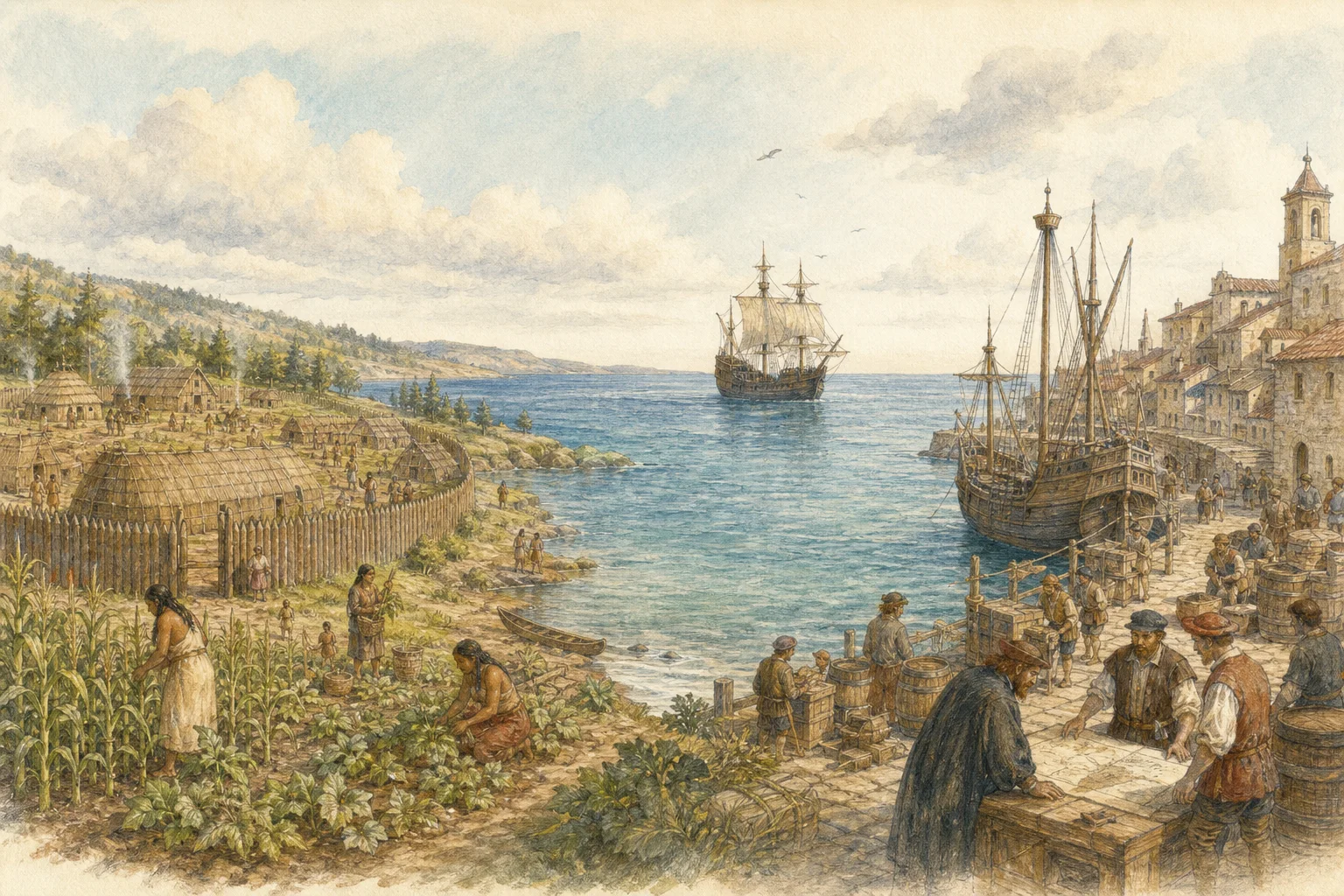
The lands that became the United States and Canada were home to hundreds of Indigenous nations with distinct languages, governments, economic systems, religious traditions, and diplomatic relationships. Communities ranged from mobile hunting and gathering groups to permanent agricultural towns and large regional political centers. No single description fits every Native society.
Indigenous nations traded goods and ideas across extensive networks, negotiated alliances, fought wars, and managed resources through accumulated knowledge. Europeans therefore entered existing political worlds. Later encounters were shaped by Native decisions about diplomacy, trade, alliance, relocation, and resistance as well as by European goals.
Core knowledge 03
Environment influenced societies, but people actively transformed environments
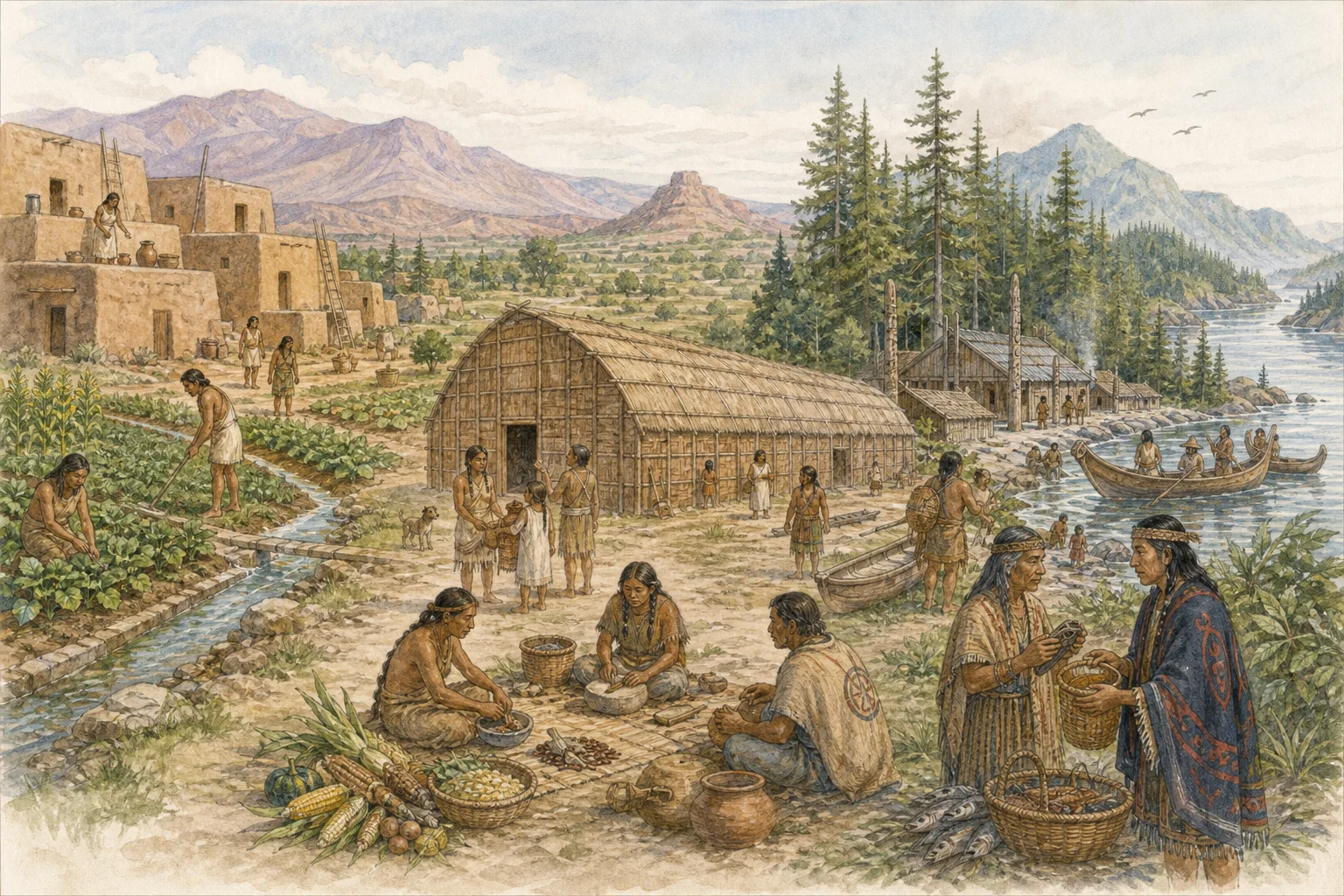
Geography affected available food, transportation, building materials, and settlement patterns. Indigenous communities responded through irrigation, controlled burning, terracing, fishing technologies, seasonal migration, selective harvesting, and the cultivation of locally suited crops. This relationship was interactive rather than environmentally determined.
The spread of maize cultivation from Mesoamerica supported population growth and more permanent settlements in many areas. Where agriculture generated surpluses, communities could sustain craft specialists, religious leaders, traders, and more complex political structures. The Three Sisters system—maize, beans, and squash—combined complementary crops, while river valleys helped move food, people, and information.
Southwest
Pueblo peoples used irrigation, drought-resistant crops, and adobe or stone construction to sustain settled communities in arid environments.
Great Basin and Plains
Many groups used seasonal mobility to follow dispersed resources. Plains communities relied heavily on bison before horses transformed mobility after European contact.
Northeast and Mississippi Valley
Maize agriculture, fertile river systems, and long-distance exchange supported settled towns, confederacies, and large ceremonial centers.
Pacific Coast
Abundant fisheries, forests, and plant resources supported dense populations, specialized labor, and extensive coastal and river trade.
Core knowledge 04
Agricultural surplus and trade supported political and social complexity
Cahokia, near the Mississippi River, reached its height before the AP course begins, but it provides essential context. Its monumental earthworks, large population, and regional exchange demonstrate that urban and ceremonial complexity existed in North America before sustained European contact. Its decline before 1491 also reminds students that Indigenous societies changed over time for reasons unrelated to Europeans.
Trade networks carried shells, copper, obsidian, textiles, food, tools, and ceremonial objects across long distances. Exchange also created alliances, distributed knowledge, expressed status, and connected communities diplomatically. The existence of these networks helps explain how both goods and epidemic diseases could later travel far beyond the location of first contact.
Atlantic context 05
European expansion grew from commerce, state rivalry, religion, and maritime knowledge
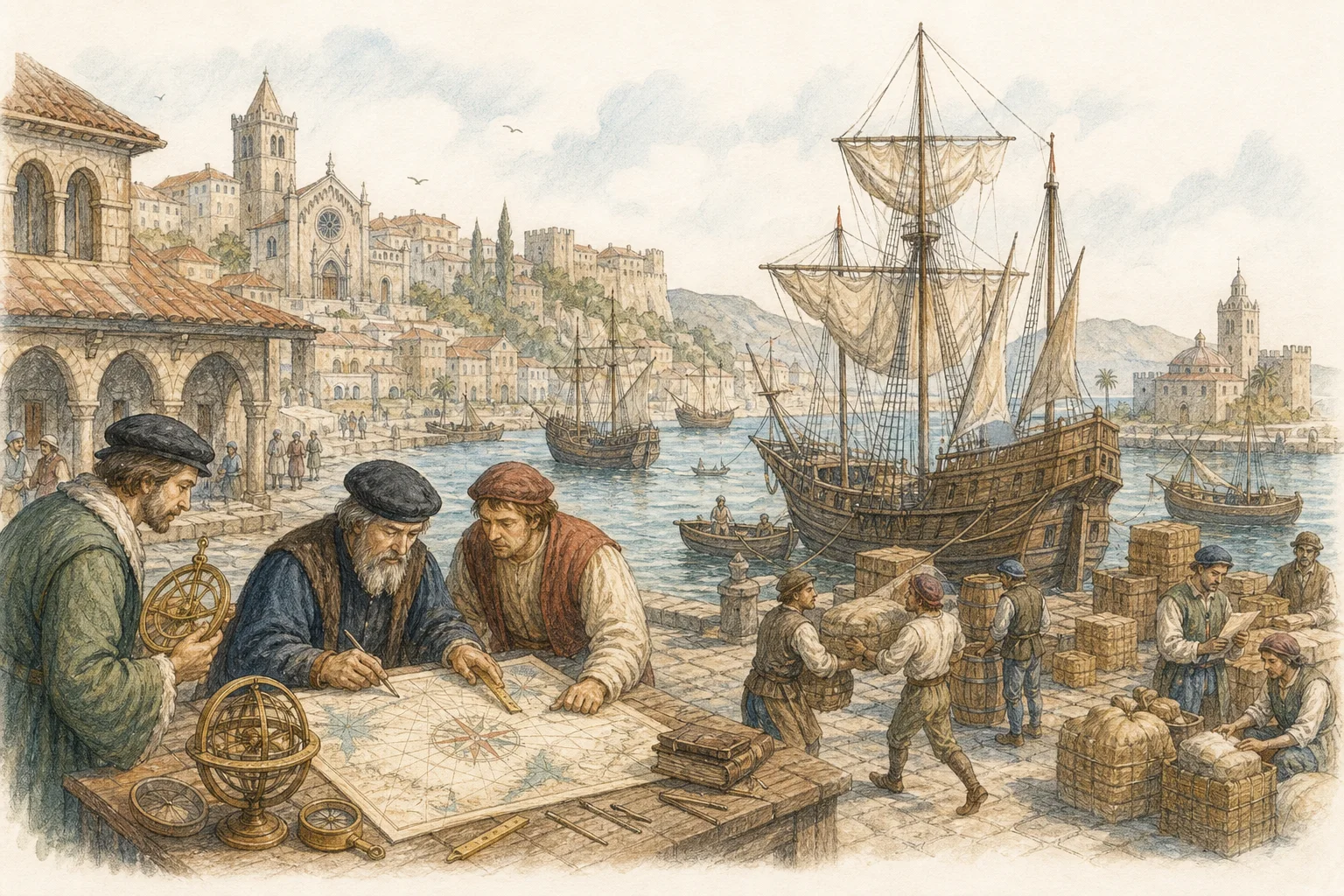
By the late fifteenth century, European monarchies and merchants sought direct access to Asian luxury goods, precious metals, new tax revenues, and strategic advantage over rival states. Christian missionary ambition and the legacy of religious warfare gave rulers and clergy additional reasons to support overseas expansion. The familiar phrase “God, gold, and glory” is useful only when unpacked into these specific motives.
Atlantic voyages depended on accumulated knowledge rather than a single invention. Mariners combined improved charts, the magnetic compass, the astrolabe, ocean-going ship designs, and practical understanding of winds and currents. Portuguese voyages along Africa’s coast linked European expansion to established African trading states and to an Atlantic slave trade that preceded Columbus and later expanded dramatically in the Americas.
Unit preview 06
Sustained contact created exchange, conquest, adaptation, and resistance
Columbus’s 1492 voyage did not represent the first human movement across the Atlantic, but it initiated sustained connections among Europe, Africa, and the Americas. Those connections produced the Columbian Exchange: the movement of plants, animals, diseases, people, technologies, and ideas. The movement was multidirectional, but its demographic and political effects were profoundly unequal.
Spanish conquests depended on steel weapons, horses, epidemic disease, and—critically—alliances with Indigenous enemies of existing empires. Colonial rule then developed through missions, tribute demands, coerced labor, African slavery, and racial classification. At every stage, Indigenous and African peoples resisted, negotiated, preserved traditions, and created new cultural forms.
Exam method 07
Build context that is accurate, relevant, and explicitly connected
For an LEQ or DBQ, begin far enough before the prompt to identify a real broader process, but do not drift into an unrelated history survey. If a prompt asks about European–Indigenous relations after 1492, useful context could explain pre-contact regional diversity and diplomacy, or European competition and commercial expansion. The best choice depends on the argument you plan to make.
For an SAQ, contextualization may be shorter: identify one relevant background development and explain the relationship in a complete sentence. Across formats, specific evidence beats vague wording. Name maize agriculture, Atlantic state competition, Portuguese maritime expansion, or Indigenous trade networks instead of saying only that “many changes were happening.”
High-yield review
Key developments
Distinct Indigenous societies
Migration, settlement, and long interaction with particular homelands produced diverse political, economic, and cultural systems across North America.
Environmental adaptation and transformation
Communities used agriculture, irrigation, controlled burning, fishing, and mobility to manage different environments.
Agriculture, surplus, and exchange
Maize cultivation and long-distance trade supported population growth, permanent settlements, specialization, and complex governance in many regions.
European commercial and political expansion
Monarchies, merchants, missionaries, and investors pursued wealth, access to trade, converts, prestige, and strategic advantage.
Maritime networks connected Europe and Africa
Ships, navigation, winds-and-currents knowledge, Portuguese coastal voyages, and African trade networks made sustained Atlantic movement possible.
Sustained encounters reshaped three continents
After 1492, exchange, disease, conquest, migration, coerced labor, adaptation, and resistance created a connected Atlantic world.
Chronological reasoning
Timeline — key moments
Cahokia grows into a major Mississippian center
Its population, monumental mounds, agriculture, and exchange networks demonstrate pre-contact urban and political complexity.
Norse voyagers reach northeastern North America
The settlement at L’Anse aux Meadows shows earlier Atlantic contact, but it did not create the sustained intercontinental system that followed 1492.
European and African Atlantic networks expand
Portuguese voyages, African coastal trade, state rivalry, and maritime learning enlarge the geographic reach of Atlantic commerce.
Bartolomeu Dias rounds southern Africa
The voyage demonstrates Portuguese progress toward a sea route connecting the Atlantic and Indian Ocean trading worlds.
Diverse Indigenous nations occupy and manage North America
Settled farmers, mobile communities, trading networks, towns, and confederacies reflect many regional adaptations rather than one Native way of life.
Columbus’s voyage begins sustained Atlantic contact
European, African, and American societies become linked through continuing voyages, settlement, exchange, conquest, and forced migration.
Spain and Portugal sign the Treaty of Tordesillas
The agreement reflects European imperial competition and claims over lands already inhabited by sovereign peoples.
Spanish and Indigenous allied forces defeat the Mexica capital
The fall of Tenochtitlan reveals how disease, technology, political rivalries, and Indigenous alliances combined in conquest.
Spain establishes St. Augustine
The settlement becomes a durable base of Spanish power in Florida and the oldest continuously occupied European-founded city in the present-day United States.
Jamestown marks a permanent English foothold
Its founding closes Period 1 and begins a new phase of English colonization and sustained conflict and exchange in the Chesapeake.
Remember these
Vocabulary
- Contextualization
- Placing a historical development within a broader setting and explaining how that setting helps account for the development.
- Indigenous sovereignty
- The authority of Indigenous nations to govern their peoples, territories, and relationships with other nations.
- Maize cultivation
- The farming of corn, which supported population growth and permanent settlements in many parts of the Americas.
- Three Sisters
- The complementary cultivation of maize, beans, and squash in a shared agricultural system.
- Mississippian culture
- A broad tradition of maize-growing societies associated with mound building, regional exchange, and complex political centers.
- Cahokia
- A major pre-contact Mississippian urban and ceremonial center near the Mississippi River, at its height centuries before 1491.
- Pueblo
- A settled Southwestern Indigenous community, and the Spanish term used for its compact adobe or stone town.
- Matrilineal
- A kinship system in which descent, clan identity, or inheritance is traced through the mother’s line.
- Trade network
- A system connecting communities through the exchange of goods, knowledge, technologies, diplomacy, and cultural practices.
- Caravel
- A maneuverable sailing vessel associated with Portuguese and Spanish Atlantic exploration.
- Mercantilism
- An economic idea that colonies and controlled trade should increase a state’s wealth and power.
- Atlantic world
- The interconnected societies and economies of Europe, Africa, and the Americas formed through Atlantic movement and exchange.
- Columbian Exchange
- The post-1492 movement of plants, animals, diseases, people, goods, and ideas between the Americas and Afro-Eurasia.
- Historical agency
- The capacity of people and communities to make choices and shape events within the constraints they face.
Clear the confusion
Frequently asked questions
20 detailed answers to the questions students most often carry into Topic 1.1.
01What does contextualization mean on the AP U.S. History exam?
Contextualization identifies a broader historical development that surrounds the event or process in the prompt and explains the connection. It is not enough to mention an earlier fact; the answer must show why that background helped shape, enable, or clarify the development being analyzed.
02Why does Period 1 begin in 1491 rather than 1492?
Beginning in 1491 directs attention to the Americas before Columbus and prevents European arrival from being treated as the start of American history. It gives students space to understand Indigenous diversity, sovereignty, environmental knowledge, and exchange networks before sustained Atlantic contact.
03Was North America sparsely populated or politically empty before Europeans arrived?
No. Population density varied by region, but North America contained hundreds of nations, many permanent towns, agricultural communities, trading systems, and complex political relationships. European claims to territory did not erase the sovereignty or prior occupation of these peoples.
04How should I explain the relationship between environment and Indigenous societies?
Explain a two-way relationship. Climate, landforms, water, plants, and animals shaped available choices, while communities actively transformed environments through irrigation, farming, controlled burning, selective harvesting, settlement design, and mobility.
05Why was maize cultivation historically important?
Maize could create reliable food surpluses in suitable environments. In many regions, surplus encouraged population growth, more permanent settlements, specialized labor, expanded trade, and increasingly complex political or ceremonial organization.
06Why is Cahokia relevant if it declined before 1491?
Cahokia provides context demonstrating that large urban, agricultural, ceremonial, and trading centers existed in North America before sustained European contact. Its earlier decline also proves that Indigenous history included change driven by internal and environmental factors, not only reactions to Europeans.
07Which Indigenous regions should I know for APUSH?
Know representative adaptations rather than memorizing every nation: Pueblo irrigation and settled towns in the Southwest; seasonal mobility in the Great Basin and parts of the Plains; maize agriculture in the Northeast and Mississippi Valley; and fishing, forestry, and dense communities along the Pacific Northwest. Use named examples carefully without claiming they represent all Native peoples.
08Did all Plains peoples use horses before European contact?
No. Horses evolved in North America but disappeared there long before the period and were reintroduced by Europeans. Their spread after contact transformed mobility, hunting, trade, and warfare for many Plains nations, so placing horse culture before 1492 is an anachronism.
09How important were Indigenous trade networks before 1492?
They were extensive and moved goods such as shells, copper, stone, food, textiles, and ceremonial objects over long distances. Trade also carried knowledge and built diplomatic relationships, showing that communities were interconnected rather than isolated.
10What types of government existed in pre-contact North America?
Political organization ranged from autonomous villages and councils to confederacies, chiefdoms, and powerful regional centers. Authority could be divided among civil, religious, clan, and military leaders, and governance varied greatly across time and place.
11What conditions encouraged European Atlantic exploration?
Important causes included demand for direct access to Asian trade, competition among consolidating monarchies, the pursuit of precious metals and tax revenue, missionary goals, personal ambition, and investment opportunities. Maritime knowledge and ship technology made these goals more achievable.
12Did better technology alone cause European exploration?
No. Compasses, charts, instruments, ship designs, and knowledge of winds enabled longer voyages, but tools do not explain why states financed them. A strong answer combines technological capacity with commercial incentives, political rivalry, and religious objectives.
13Is “God, gold, and glory” enough for an APUSH answer?
It is a useful memory device but too vague by itself. Translate it into precise causes such as Catholic missionary ambition, access to Asian luxury trade and precious metals, royal tax revenue, competition with rival states, or opportunities for individual status.
14What role did Africa play in the context of Period 1?
African kingdoms and merchants were already part of major regional and trans-Saharan trading networks, and Portuguese coastal voyages increasingly connected those systems to Atlantic commerce. The coerced movement of Africans across the Atlantic began before 1492 and expanded sharply as American colonies demanded labor.
15Was Columbus the first person to cross the Atlantic?
No. Indigenous peoples had populated the Americas for thousands of years, and Norse voyagers reached northeastern North America around 1000. Columbus’s historical significance lies in initiating sustained voyages and imperial connections that permanently linked Europe, Africa, and the Americas.
16Why is Indigenous agency important when contextualizing contact?
Europeans entered political worlds they did not control. Indigenous nations chose when to trade, ally, resist, relocate, or use newcomers in existing rivalries; these decisions significantly shaped European survival and the outcomes of conquest.
17How do disease and the Columbian Exchange fit Topic 1.1?
They are best used as a preview of the transformations that sustained contact produced. In contextualization, mention that previously separated disease environments and ecosystems were about to become connected; detailed demographic consequences belong especially to Topic 1.4.
18What is a strong comparison for Topic 1.1?
Compare two regions using the same category, such as food production, settlement pattern, or resource management. For example, contrast Pueblo irrigation-based agriculture with the fishing and forest economies of the Pacific Northwest, then connect the difference to environmental opportunities and community choices.
19How can Topic 1.1 appear in an SAQ, DBQ, or LEQ?
An SAQ may ask for one contextual factor or regional adaptation. In a DBQ or LEQ, Topic 1.1 evidence often supplies a contextualization paragraph for arguments about exploration, colonization, Indigenous–European relations, labor systems, or environmental change.
20What would a defensible contextualization claim for Period 1 look like?
A strong claim might explain that before sustained European contact, diverse Indigenous nations had developed regionally adapted economies and political networks, while European states were expanding commerce and maritime capacity. Those simultaneous developments shaped the unequal but negotiated encounters that followed 1492.
Use the knowledge
AP exam connections
- 1
Use one broader process, one specific piece of evidence, and an explicit link to the prompt.
- 2
Compare two Indigenous regions through the same category and explain the environmental and human causes of difference.
- 3
Explain European exploration through multiple causes: commercial, political, religious, and technological.
- 4
Treat Indigenous and African peoples as actors whose choices shaped Atlantic encounters.
- 5
Distinguish pre-1492 context from post-1492 consequences when building chronology.
Editorial trust
Sources and review
These notes are original OnlyPrepy content. The syllabus scope and historical framing were checked against the following authoritative sources on August 15, 2026.
- AP U.S. History Course and Exam DescriptionCollege Board
- Native Life and Food: Food Is More Than Just What We EatSmithsonian National Museum of the American Indian
- Early History and Relationships Between NationsSmithsonian National Museum of the American Indian
- Europe Claims America: The Atlantic JoinedLibrary of Congress