The big picture
Explore how geography, climate, agriculture, and exchange shaped diverse Indigenous societies across North America before sustained European contact.
Exam foundation 01
Start with diversity—not a single Native American society
In 1491, North America was home to hundreds of sovereign Indigenous nations with distinct languages, governments, spiritual traditions, economies, and diplomatic relationships. The broad labels used in textbooks describe patterns useful for study, but they must not erase differences among nations or suggest one shared Native way of life.
APUSH Topic 1.2 focuses on a two-way relationship between people and place. Climate, landforms, water, plants, and animals shaped available choices, while communities actively transformed environments through agriculture, irrigation, controlled burning, selective harvesting, fishing technologies, settlement design, and seasonal movement.
Comparison 02
Use regions as comparison tools, not rigid cultural boxes
The AP framework groups societies by broad environmental patterns because geography helps explain differences in food production, mobility, settlement, and exchange. These are analytical categories rather than fixed borders. People migrated, intermarried, traded, formed alliances, fought wars, and shared knowledge across the regions summarized below.
On the exam, compare the same category across two regions. Do not compare Southwestern food production with Northeastern government, for example. Compare food with food, settlement with settlement, or resource management with resource management—and then explain why the pattern differed.
| Region | Environmental conditions | Adaptations and economy | Settlement and useful evidence |
|---|---|---|---|
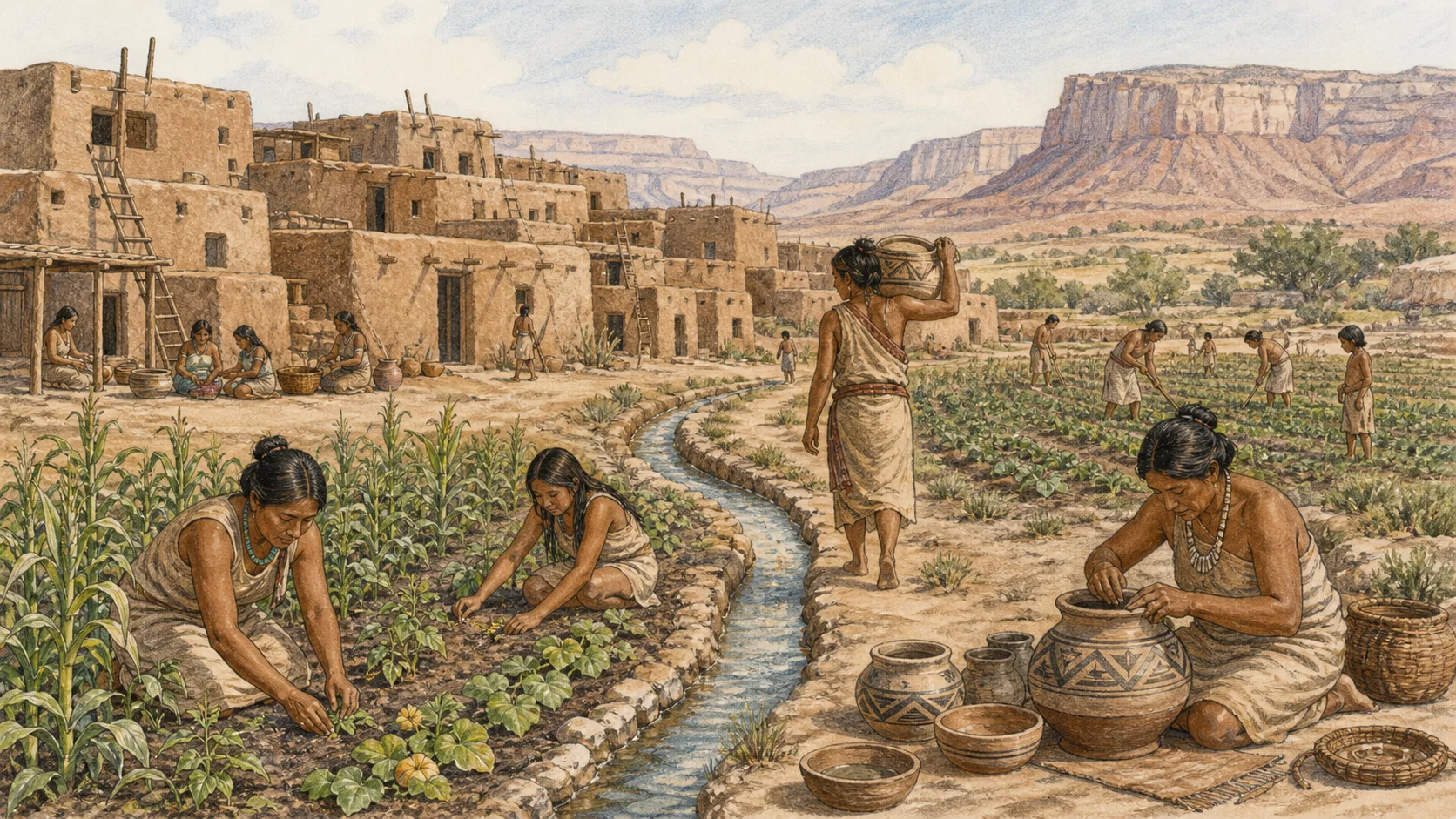
| Southwest | Arid climate, limited rainfall, river valleys and mesas | Irrigation, drought-resistant maize, beans and squash, water storage, pottery | Permanent Pueblo towns; adobe and stone construction; canal systems |
| Great Basin | Dry interior, dispersed plants and game, strong seasonal variation | Seasonal gathering and hunting; movement between resource zones; careful use of seeds and roots | Smaller, mobile or semi-sedentary communities adapted to scarce resources |
| Great Plains | Grasslands, large bison herds, river valleys | Bison hunting, gathering, river-valley farming in some areas, regional exchange | Both mobile and settled communities; horses spread only after European reintroduction |
| Northeast / Eastern Woodlands | Forests, rivers, fertile soils, varied seasons | Three Sisters agriculture, hunting, fishing, controlled burning, trade | Longhouses or other permanent dwellings; towns and confederacies |
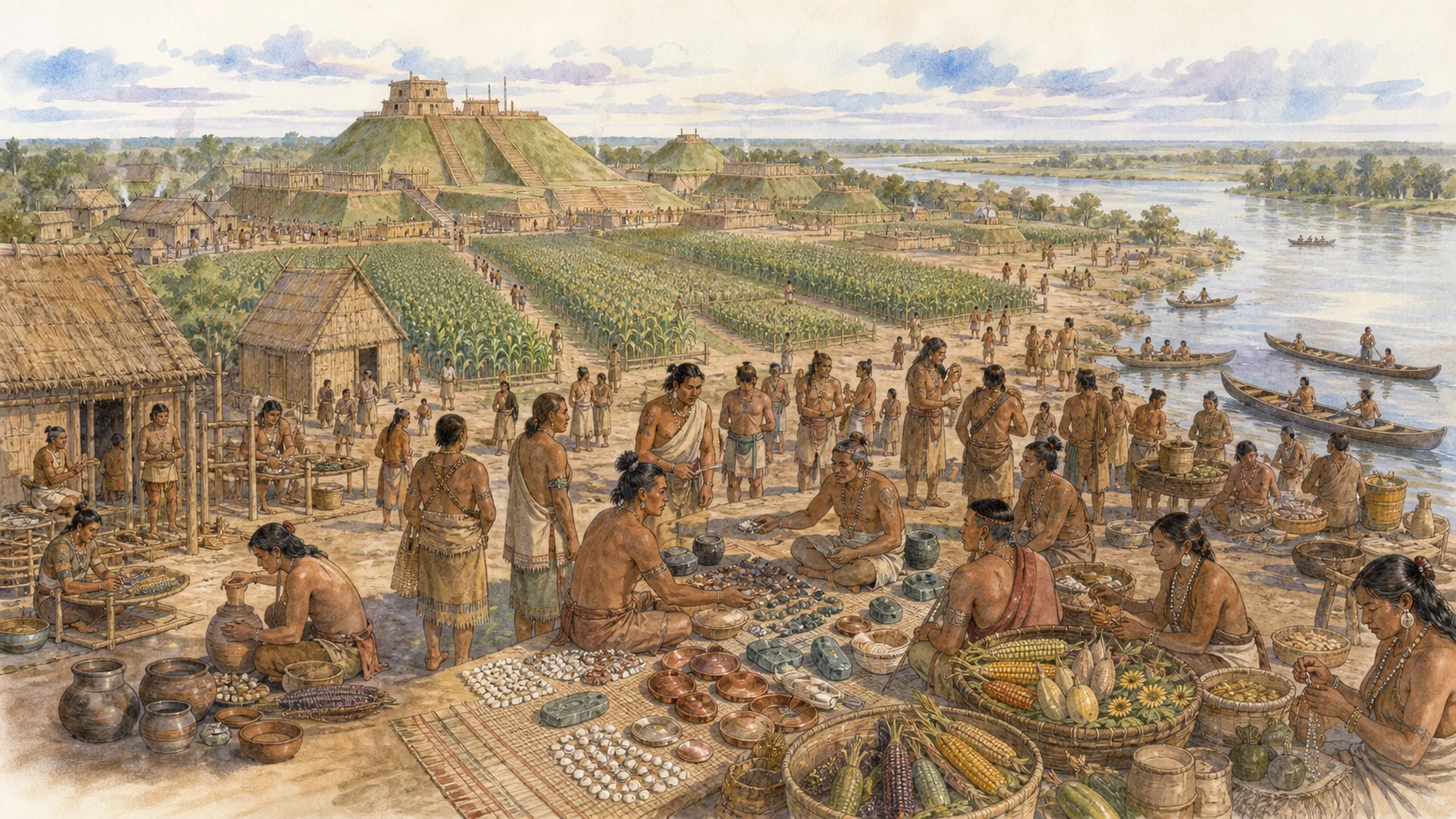
| Mississippi Valley / Southeast | Fertile floodplains and navigable river systems | Intensive maize farming, craft specialization, river trade and tribute | Large towns and mound centers; Cahokia as evidence of urban and ceremonial complexity |
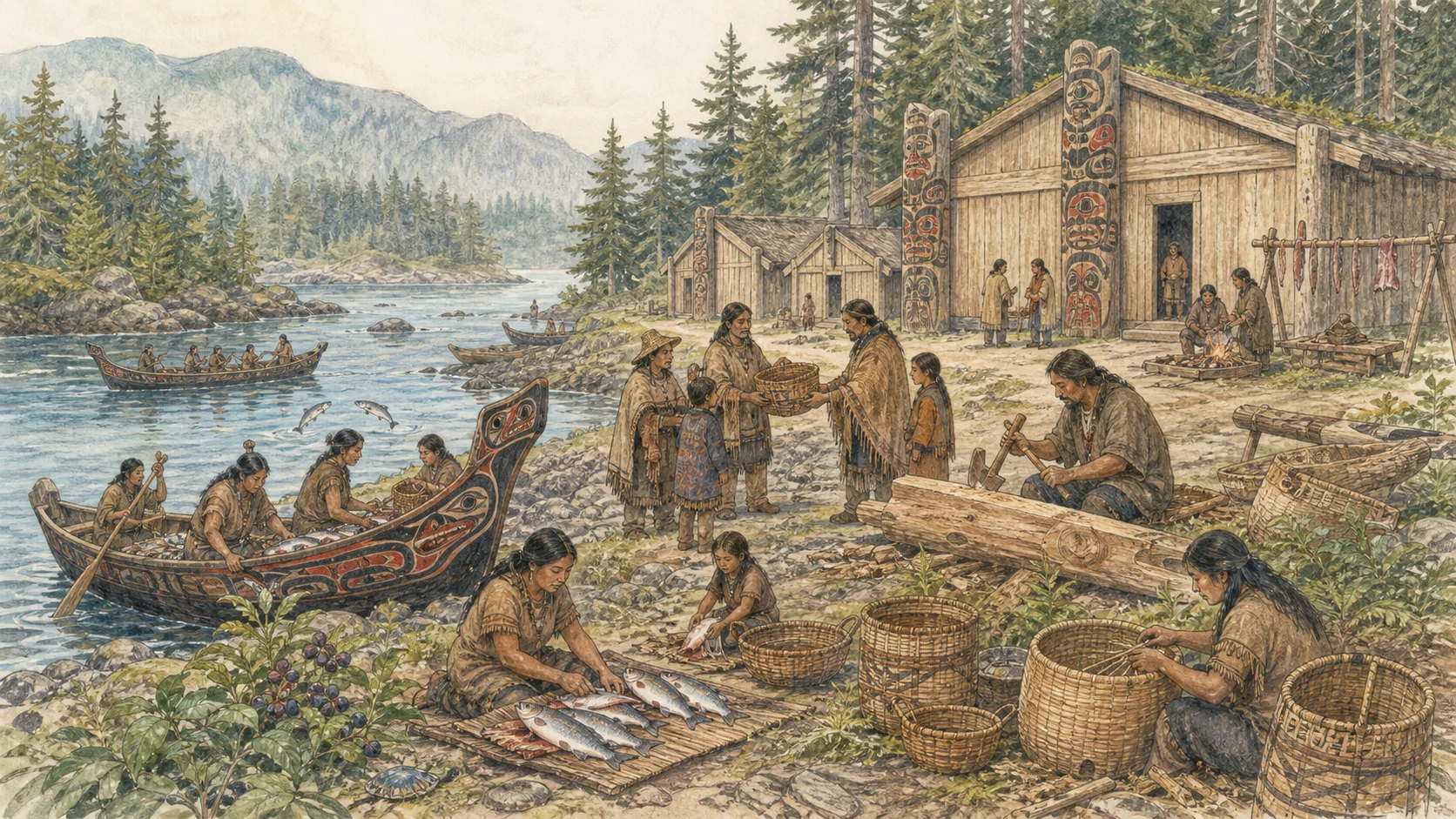
| Pacific Northwest | Cedar forests, rivers, coastline, abundant salmon and marine resources | Fishing, preservation and storage, woodworking, canoe travel, weaving and exchange | Permanent plank-house communities; dense populations without reliance on intensive maize farming |
| California | Highly varied coasts, valleys, mountains and oak woodlands | Acorn processing, fishing, hunting, gathering, controlled burning and local trade | Numerous distinct communities with high linguistic and ecological diversity |
Regional evidence 03
The Southwest, Great Basin, and Plains produced different mobility and food systems
In the arid Southwest, ancestral Pueblo and other communities invested in irrigation, water storage, terracing, and drought-conscious agriculture. Maize, beans, and squash supported permanent towns, while adobe and stone construction used locally available materials and moderated temperature. Pottery stored food and water, and exchange connected communities to wider networks.
The Great Basin’s dispersed resources encouraged many communities to move seasonally among hunting, seed-gathering, root-gathering, and fishing locations. Across the Great Plains, societies used bison for food, hides, tools, and shelter materials; some also farmed in river valleys. The familiar horse-centered Plains economy developed after Europeans reintroduced horses, so it should not be projected backward into 1491.
Regional evidence 04
Eastern agriculture and river networks supported towns, confederacies, and major centers
In parts of the Northeast and Eastern Woodlands, maize, beans, and squash supplemented hunting, fishing, and gathering. Permanent villages and longhouses reflected settled community life. Controlled burning could clear undergrowth, encourage useful plants, improve hunting conditions, and demonstrate active environmental management rather than untouched “wilderness.”
The Mississippi River and its tributaries connected fertile agricultural lands to extensive movement and exchange. Cahokia reached its height centuries before 1491, yet its mounds, population, craft production, and regional influence remain vital evidence that complex urban and ceremonial centers developed independently in North America. Later Mississippian societies continued across the Southeast after Cahokia’s decline.
Regional evidence 05
Pacific Coast abundance supported settled communities without intensive maize agriculture
In the Pacific Northwest, reliable salmon runs, coastal waters, forests, and other resources could support dense, permanent communities without depending on intensive grain agriculture. Cedar supplied material for plank houses, canoes, tools, storage containers, and art. Specialized fishing and preservation technologies made seasonal abundance available over longer periods.
California contained especially high linguistic and ecological diversity. Communities developed locally specific economies based on combinations of acorn processing, fishing, hunting, gathering, trade, and controlled burning. Neither “hunter-gatherer” nor “farmer” by itself captures the knowledge, labor, storage, and land management involved in these systems.
Systems 06
Agriculture, storage, and exchange supported population and specialization
The long spread of maize cultivation northward from Mesoamerica transformed many—but not all—communities. Where climate and soils supported farming, food surplus could encourage population growth, permanent settlement, craft specialization, religious leadership, and more layered political authority. The Three Sisters system combined maize, beans, and squash in a mutually supportive planting pattern.
Storage was as important as production. Granaries, pottery, drying, smoking, and other preservation techniques reduced seasonal risk. Long-distance exchange moved shells, copper, obsidian, stone, food, textiles, and ideas. Trade also built alliances, expressed status, carried knowledge, and linked communities through diplomacy and ceremony.
Political worlds 07
Kinship, councils, confederacies, and diplomacy organized political life
Indigenous governments ranged from autonomous towns and village councils to confederacies, chiefdoms, and influential regional centers. Authority might be divided among civil, clan, religious, and military leaders. Political organization was neither uniform nor static; communities reorganized, migrated, combined, or divided in response to changing conditions.
Kinship systems structured responsibility, identity, property, and diplomacy. Some nations were matrilineal, tracing clan identity through the mother’s line, while others followed different systems. Nations negotiated alliances, trade, peace, and war long before Europeans arrived. After contact, Indigenous leaders evaluated newcomers through these existing political traditions and pursued strategies intended to protect their people and power.
Exam method 08
Turn regional evidence into comparison, causation, and contextualization
For comparison, keep the category constant and explain both similarity or difference and cause. A strong sentence might contrast Southwestern irrigation agriculture with Pacific Northwest fishing and storage, then connect those adaptations to aridity in one region and abundant river and coastal resources in the other.
For causation, trace a development such as maize cultivation to surplus, settlement, and specialization. For contextualization, establish that Europeans entered lands occupied by diverse, sovereign, and connected societies. Avoid a progress ladder: mobility was not primitive, and permanent settlement was not automatically superior.
High-yield review
Key developments
Regional diversity
Hundreds of sovereign nations developed distinct economies, languages, governments, and cultural traditions across North America.
Environmental adaptation and transformation
Communities used irrigation, controlled burning, selective harvesting, fishing technologies, farming, and mobility to manage particular homelands.
Agriculture and food surplus
Maize and Three Sisters cultivation supported population growth, permanent settlement, storage, specialization, and political complexity in many regions.
Specialized nonagricultural abundance
Pacific fisheries, California plant management, and Great Basin seasonal knowledge supported complex societies without intensive maize agriculture.
Long-distance exchange
Goods, technologies, knowledge, and cultural practices moved through river, trail, coastal, and diplomatic networks.
Sovereignty, kinship, and diplomacy
Councils, clans, confederacies, chiefdoms, and other governments organized collective decisions and nation-to-nation relations.
Chronological reasoning
Timeline — key moments
Maize cultivation spreads northward over many centuries
Communities selectively adopted and adapted maize to local climates; the process was gradual and varied rather than one sudden agricultural revolution.
Hopewell exchange networks connect distant regions
Materials and ceremonial objects moved across broad portions of eastern North America, demonstrating long-distance interaction well before 1491.
Hohokam communities expand Southwestern canal irrigation
Large canal systems in present-day Arizona supported farming and settlement in a demanding desert environment.
Ancestral Pueblo communities develop major settlements
Agriculture, masonry and adobe architecture, roads, exchange, and ceremonial spaces supported complex Southwestern societies.
Mississippian traditions spread across the river valleys and Southeast
Maize agriculture, mound centers, tribute, trade, and regional political authority appeared in varied local forms.
Cahokia becomes a major urban and ceremonial center
Its mounds, population, agricultural base, and exchange networks provide powerful evidence of pre-contact complexity.
Norse voyagers briefly settle at L’Anse aux Meadows
The episode produced limited contact in the northeast but not the sustained Atlantic system that followed 1492.
Southwestern communities reorganize and migrate
Climate stress, conflict, exchange, and political change contributed to movement into new settlements, showing that Indigenous societies changed before Europeans.
Confederacies and diplomatic networks link multiple nations
Many communities used councils, kinship, alliance, and exchange to manage relations beyond a single town or nation.
North America contains diverse and connected societies
Settled towns, mobile communities, agricultural regions, fisheries, trade routes, and sovereign political systems form the immediate context for European contact.
Remember these
Vocabulary
- Indigenous sovereignty
- The authority of Indigenous nations to govern their own peoples, lands, and political relationships.
- Environmental adaptation
- A way a community adjusts its economy, settlement, or technology to particular environmental conditions.
- Environmental transformation
- Deliberate human alteration or management of landscapes through practices such as irrigation, farming, burning, or selective harvesting.
- Cultural region
- A broad analytical area in which societies share some environmental or cultural patterns, without implying that every community is the same.
- Maize cultivation
- The farming of corn, which supported population growth and settled communities in many regions.
- Three Sisters
- The interplanting of maize, beans, and squash, crops that support one another nutritionally and agriculturally.
- Pueblo
- A settled Southwestern community, and the Spanish term used for its multi-story town or village.
- Irrigation
- The controlled movement of water to crops, especially important to agriculture in arid regions.
- Sedentary
- Living primarily in a permanent settlement rather than moving the entire community seasonally.
- Seasonal mobility
- Planned movement among locations at different times of year to use dispersed resources sustainably.
- Cahokia
- A major Mississippian urban and ceremonial center near the Mississippi River that peaked before 1491.
- Mississippian
- A broad tradition of maize-growing societies associated with mound centers, regional exchange, and varied forms of political authority.
- Longhouse
- A long, shared dwelling used by some Eastern Woodlands peoples and often connected to household or clan organization.
- Matrilineal
- A kinship system in which descent or clan identity is traced through the mother’s line.
- Confederacy
- An alliance of distinct nations or political communities that cooperate while retaining their own identities.
- Controlled burning
- The deliberate use of fire to manage plants, improve habitat, clear undergrowth, or support hunting and food production.
- Trade network
- A connected system through which communities exchange goods, knowledge, technologies, and relationships.
- Historical agency
- The ability of people and communities to make choices and shape outcomes within environmental and political constraints.
Clear the confusion
Frequently asked questions
20 detailed answers to the questions students most often carry into Topic 1.2.
01Were all Native American societies similar before European contact?
No. North America contained hundreds of nations with different languages, governments, economies, kinship systems, spiritual traditions, and relationships to specific homelands. Regional labels are useful for comparison, but they should never replace the diversity of actual peoples.
02Did the environment determine Indigenous culture?
Environment influenced available resources and risks, but it did not mechanically determine culture. Communities made choices, exchanged knowledge, migrated, innovated, and actively transformed landscapes through irrigation, agriculture, controlled burning, fishing, storage, and settlement design.
03Which regional patterns matter most for APUSH Topic 1.2?
Know representative contrasts: Southwestern irrigation and settled Pueblo towns; Great Basin seasonal mobility; Plains bison economies; Eastern and Mississippian agriculture; Pacific Northwest fishing and cedar technologies; and California’s highly varied gathering, fishing, burning, and trade systems. The exam rewards explanation more than memorizing exhaustive lists.
04How did Southwestern peoples adapt to an arid climate?
Many communities developed canal irrigation, water storage, terracing, drought-resistant crop varieties, and compact adobe or stone settlements. These technologies reflect accumulated environmental knowledge and collective labor rather than simple dependence on geography.
05Why were many Great Basin communities mobile?
Water, seeds, roots, game, and other resources were dispersed and changed seasonally. Planned mobility allowed communities to move among known resource zones; it was an efficient adaptation, not evidence that societies lacked organization or knowledge.
06Did Plains peoples use horses before 1492?
No. Horses had disappeared from North America long before the period and were reintroduced by Europeans. Many Plains communities hunted bison and some farmed near rivers before horses later transformed mobility, trade, hunting, and warfare.
07How did Eastern Woodlands societies manage their environment?
Many combined Three Sisters agriculture with hunting, fishing, gathering, and controlled burning. Burning could clear undergrowth, support useful plants, and improve hunting habitats, showing that apparently natural landscapes were often actively managed.
08What was Cahokia, and why is it important?
Cahokia was a large Mississippian urban and ceremonial center near present-day St. Louis. Its monumental mounds, dense population, agricultural base, specialization, and exchange connections disprove claims that complex cities and regional political systems were absent from pre-contact North America.
09Was Cahokia still at its height in 1491?
No. Cahokia peaked roughly between the tenth and thirteenth centuries and declined before sustained European contact. Use it as earlier context and evidence of Indigenous urban complexity, not as a city Europeans encountered at its peak.
10How could Pacific Northwest societies be densely settled without maize agriculture?
Reliable salmon runs, marine resources, forests, and sophisticated preservation and storage supported permanent communities. Cedar woodworking, canoe travel, fishing technologies, and exchange created specialized economies without intensive grain farming.
11Why is California difficult to describe as one cultural region?
California contains coasts, valleys, mountains, deserts, oak woodlands, and many microclimates, and it supported exceptional linguistic and cultural diversity. Communities used different combinations of acorn processing, fishing, hunting, gathering, burning, and trade.
12Why was maize so significant?
In suitable environments, maize could produce surplus that supported population growth, permanent settlement, storage, craft specialization, and more complex political or ceremonial organization. Its effects varied because communities adopted it at different times and combined it with local foods.
13What were the Three Sisters?
Maize, beans, and squash were often planted together because they complemented one another: maize provided a stalk, beans helped restore soil nitrogen, and squash covered the ground. The foods also offered complementary nutrition and reduced agricultural risk.
14How extensive were pre-contact trade networks?
Goods such as shells, copper, obsidian, stone, food, textiles, and ceremonial objects moved over long distances through trails, rivers, and coastal routes. Exchange also carried technologies and ideas and helped build alliances, obligations, and political status.
15What kinds of government existed in Indigenous North America?
Political systems ranged from town councils and clan-based leadership to confederacies, chiefdoms, and influential regional centers. Authority could be shared among civil, religious, diplomatic, and military leaders, and structures changed over time.
16What does matrilineal mean, and did it apply everywhere?
Matrilineal systems trace clan membership, descent, or inheritance through the mother’s line. Some Indigenous nations used matrilineal organization, but others followed different kinship systems, so the term must not be generalized to all Native peoples.
17Why is Indigenous sovereignty important for this topic?
Sovereignty recognizes Indigenous nations as political communities with authority over their peoples, territories, and external relations. Europeans entered lands governed through existing laws, councils, alliances, and diplomatic traditions rather than politically empty space.
18What is the best way to compare two regions on an APUSH question?
Choose one category—such as food production, settlement, mobility, or resource management—and apply it to both regions. State a similarity or difference, give specific evidence for each side, and explain how environmental conditions and human choices produced the pattern.
19How can Topic 1.2 support a continuity-and-change argument?
Before contact, societies already changed through migration, climate pressures, agricultural adoption, political reorganization, and exchange. After 1492, communities continued exercising agency and preserving traditions even while disease, trade, colonial violence, and new technologies transformed their circumstances.
20What mistakes should I avoid when writing about pre-contact societies?
Avoid treating all Native peoples as one culture, describing the land as empty wilderness, placing horses on the pre-1492 Plains, calling mobile societies primitive, or presenting Indigenous peoples only as future victims of colonization. Use precise regions, active verbs, and historically specific evidence.
Use the knowledge
AP exam connections
- 1
Compare Southwestern irrigation agriculture with Pacific Northwest fishing and storage using environment, food production, and settlement as consistent categories.
- 2
Explain maize cultivation as a cause of surplus, population growth, specialization, and political complexity in many regions.
- 3
Use Cahokia accurately as pre-1491 evidence rather than as a city at its peak when Europeans arrived.
- 4
Explain one way communities adapted to an environment and one way they actively transformed it.
- 5
Use Indigenous sovereignty, trade, and diplomacy as context for later European–Indigenous encounters.
Editorial trust
Sources and review
These notes are original OnlyPrepy content. The syllabus scope and historical framing were checked against the following authoritative sources on August 15, 2026.
- AP U.S. History Course and Exam DescriptionCollege Board
- Native Life and Food: Food Is More Than Just What We EatSmithsonian National Museum of the American Indian
- Early History and Relationships Between NationsSmithsonian National Museum of the American Indian
- Native American Treaties: Northern Plains — Worldviews MapSmithsonian National Museum of the American Indian