Quick start
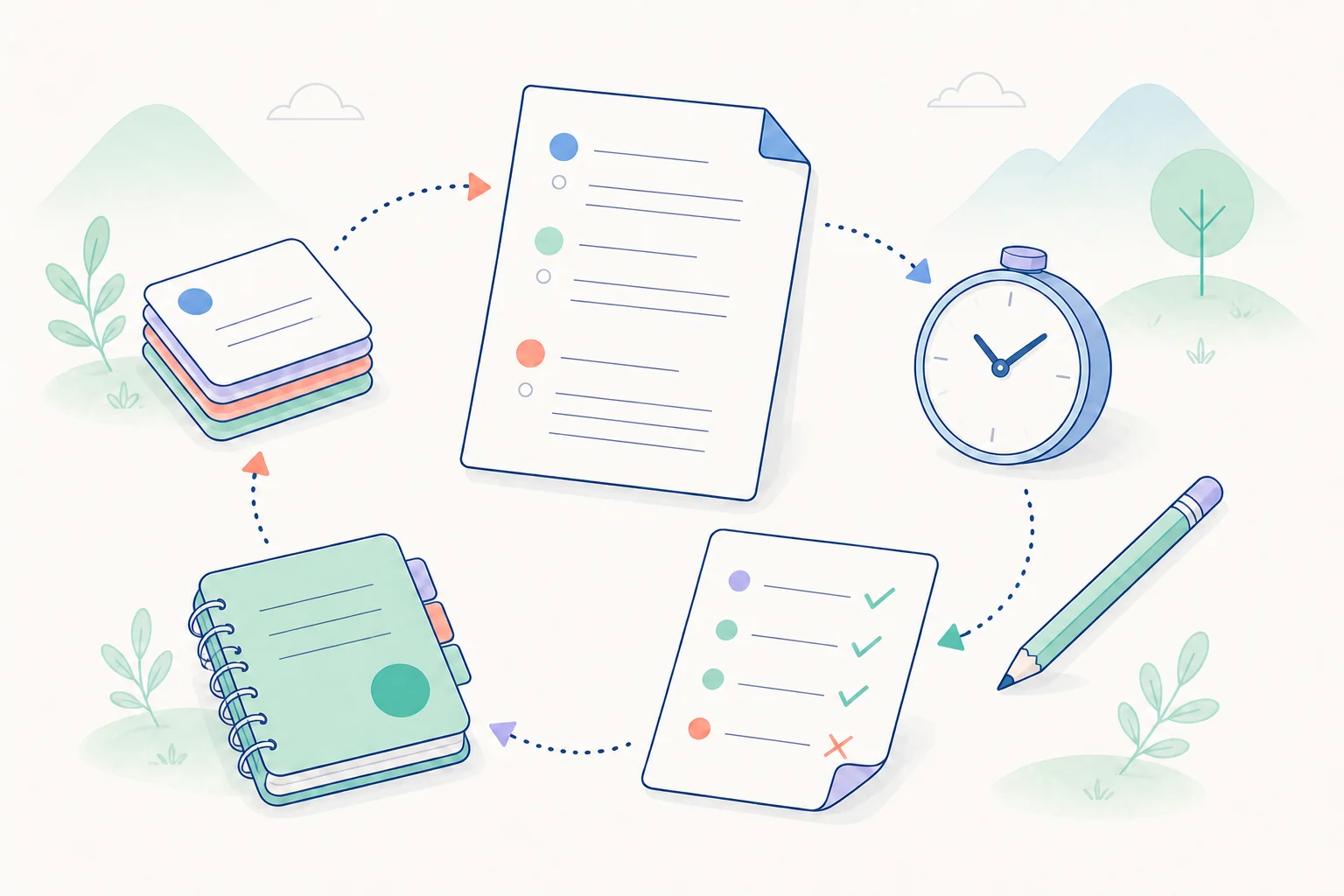
Use every paper in four deliberate passes
- 1
Choose. Match the paper to your current syllabus, format, and practice purpose.
- 2
Simulate. Decide which exam conditions matter for this attempt and protect them.
- 3
Mark. Use the official scheme, examiner guidance, and credited examples where available.
- 4
Repair. Convert each important error into one specific study or practice action.
Protect useful practice
Choose a paper that matches the skill you need
A past paper is most useful when it resembles the assessment you are preparing for. Check the qualification, subject, level, syllabus version, component, paper code, permitted materials, and question format before you begin. An older paper can still provide valuable questions, but a revised specification may test different content, timing, or assessment objectives.
Prefer official exam-board pages, your school, your teacher, or another authorized source. Official collections may include more than the paper itself: scoring guidelines, mark schemes, examiner reports, sample responses, and marking notes reveal the standard that a raw question cannot show on its own.
Practise in layers
Separate learning sessions from full simulation
Starting with a full timed paper can expose gaps, but it can also mix too many problems at once. Early in revision, work one representative question and learn what a credited response requires. Next, combine questions into a timed section. Use complete exam-condition papers when you are ready to practise pacing, stamina, order decisions, and recovery after a difficult item.
Explore
One question. Commit to an answer, then study how credit is awarded.
Section sprint
A realistic group of questions with a planned time checkpoint.
Full simulation
The current structure, duration, materials, and breaks as closely as practical.
Targeted return
Fresh questions on the exact knowledge, method, or pacing issue you found.
Practise the workflow
Build and review a past-paper session
Choose the pressure level, run a focused attempt, then turn the marks into repair work.
Complete one official section with only the materials your exam permits. Mark it immediately afterward. Use 45 minutes for this practice block, or replace it with the current official duration for your paper.
This tool runs only in the current tab. Your paper, notes, marks, and review choices are not saved or sent.
Make the attempt honest
Match only the exam conditions this session needs
Simulation is useful when the conditions are deliberate. Use the current official duration, permitted calculator or reference materials, answer format, and break rules. Put away notes, silence notifications, and decide how you will handle a question that stalls. For a section sprint, keep the same standards inside a smaller block rather than pretending it was a full paper.
Do not inherit a duration from an older paper if the current format has changed.
Practise the same calculator, formula sheet, sources, or no-materials rule you will face.
Base it on sections or available marks, then move on when one question begins consuming the whole paper.
Look beyond the total
Mark to understand how credit is awarded
Start with the official mark scheme or scoring guideline, but do not reduce it to a model answer you must copy. Cambridge notes that mark-scheme answers may not be the only acceptable wording, while official AP materials pair questions with scoring information and student samples. Examiner reports and annotated responses can show common errors, the quality of explanation expected, and why two superficially similar answers receive different credit.
Identify the exact phrase, step, evidence, or decision that gained each mark.
Name the missing requirement instead of writing only “wrong” beside the response.
Write how the same requirement could appear in a different question or context.
Diagnose before repeating
Turn each important error into a different repair
“Do more past papers” is too broad to fix a recurring problem. Classify the cause. A knowledge gap needs relearning and retrieval. A missed command word needs question annotation. Weak evidence or working needs a credited example and a fresh application. A pacing problem needs a shorter timed block. A careless slip needs a concrete verification step.
Keep the error log compact: paper, question, lost-credit reason, repair, and next check. Record patterns, not every scratch or awkward sentence. When the same category appears repeatedly, pause full-paper practice long enough to train that skill directly.
Close the loop
Repair, wait, and return with a fresh question
Practice testing has broad evidence as a learning technique, especially when attempts receive useful feedback. The next attempt should test the repaired skill, not merely repeat the same answer from memory. Use a parallel question, change the source or data, or return after a delay so the response must be produced again.
Repair the highest-impact knowledge or method gap.
Use a fresh item that requires the same assessment skill.
Check whether the error shrinks under realistic timing and conditions.
Do not chase a perfect score by memorising one mark scheme. The goal is to transfer the corrected skill to an unseen paper.
Editorial trust
Official and research sources
This guide combines official assessment resources with evidence on practice testing and corrective feedback. It was reviewed on August 14, 2026.
- 01Free-Response Questions and Scoring Information From Past AP ExamsCollege Board · AP Central
Official course-specific released questions, scoring information, and student samples.
- 02Learning and Revision: Past Papers and Mark SchemesCambridge International Education · Cambridge International
Official guidance on using past papers, mark schemes, and example candidate responses.
- 03Find Past Papers and Mark SchemesAQA · AQA assessment resources
Official papers, mark schemes, and examiner reports organized by subject and series.
- 04Diploma Programme Sample Exam PapersInternational Baccalaureate · IB assessment and exams
Official examples of past and specimen papers with selected marking notes and markschemes.
- 05Improving Students’ Learning With Effective Learning TechniquesDunlosky, Rawson, Marsh, Nathan, and Willingham · Psychological Science in the Public Interest, 2013
A broad review rating practice testing and distributed practice as high-utility techniques.
- 06Feedback Enhances the Positive Effects and Reduces the Negative Effects of Multiple-Choice TestingButler and Roediger · Memory & Cognition, 2008
Evidence that feedback can strengthen correct retention and reduce later intrusions.
Common questions
Past-paper practice FAQs
How many past papers should I complete?
There is no useful universal number. One carefully marked paper that produces specific repair work can teach you more than several rushed attempts. Track whether the same errors are shrinking, then increase the amount of timed practice as the exam approaches.
Should every past-paper session be timed?
No. Early sessions can be untimed or limited to one question while you learn the task and marking standard. Later sessions should include timed sections and full simulations so pacing becomes part of the skill.
Can I use papers from any website?
Prefer the official exam board, your school, your teacher, or another authorized source. Check the syllabus version and paper format before practising, and avoid unauthorized copies that may be incomplete, altered, or posted without permission.
Does my raw percentage predict my final grade?
Not by itself. Component weighting, grade boundaries, scaling, and exam difficulty vary by qualification and session. Treat the percentage as a practice snapshot and use official scoring guidance when it is available.
Is the past-paper session builder saved anywhere?
No. The paper title, session choice, working notes, marks, error categories, and next action remain only in the current tab and are not stored or sent.