The big picture
Synthesize Period 1 by ranking the causes of transatlantic voyages and tracing their demographic, environmental, economic, social, and political effects through 1607.
Exam focus 01
Topic 1.7 turns the events of Period 1 into a defensible causal argument
The College Board learning objective for Topic 1.7 asks students to explain the effects of the development of transatlantic voyages from 1491 to 1607. That wording requires more than a chronology. A strong answer identifies a development, explains the process that connected it to an outcome, supports the relationship with specific evidence, and recognizes that several causes or effects could operate at once.
Period 1 began with diverse Indigenous societies already adapting to and transforming their environments. It ended with sustained connections among Europe, Africa, and the Americas, an expanding Spanish empire, catastrophic Indigenous population loss, coerced Indigenous and African labor, new mixed societies, and intensifying imperial competition. These changes were unequal, but they were never produced by Europeans acting alone; Indigenous diplomacy and resistance and African knowledge, labor, community building, and resistance shaped every stage.
Reasoning skill 02
Build causation through context, mechanism, significance, and qualification
Causation is the analysis of why a historical development happened and what it produced. Historical events rarely have one cause. Separate motivating forces—such as profit, Christian expansion, and rivalry among monarchies—from enabling conditions—such as ocean-going ships, navigational knowledge, credit, and accumulated experience with Atlantic winds. Then decide which cause was primary for the question being asked.
Effects also unfold on different timescales. Epidemic mortality could be immediate, while weakened political networks and colonial labor shortages developed through repeated outbreaks and imperial pressure. A sophisticated argument therefore distinguishes short-term from long-term effects, evaluates relative importance, and adds a qualification showing where the pattern varied or where another factor changed the outcome.
Context
Identify the broader conditions already in place before the development named in the prompt.
Cause
Name a precise motive, condition, decision, or process rather than a vague force such as ‘change.’
Mechanism
Explain the link: what did the cause allow, encourage, disrupt, finance, spread, or reorganize?
Effect
State the specific demographic, environmental, economic, social, political, or cultural outcome.
Evaluation
Rank importance, compare timescales, and qualify the claim with regional variation, contingency, or agency.
Major causes 03
Commercial ambition and state rivalry drove voyages, while knowledge and capital made them sustainable
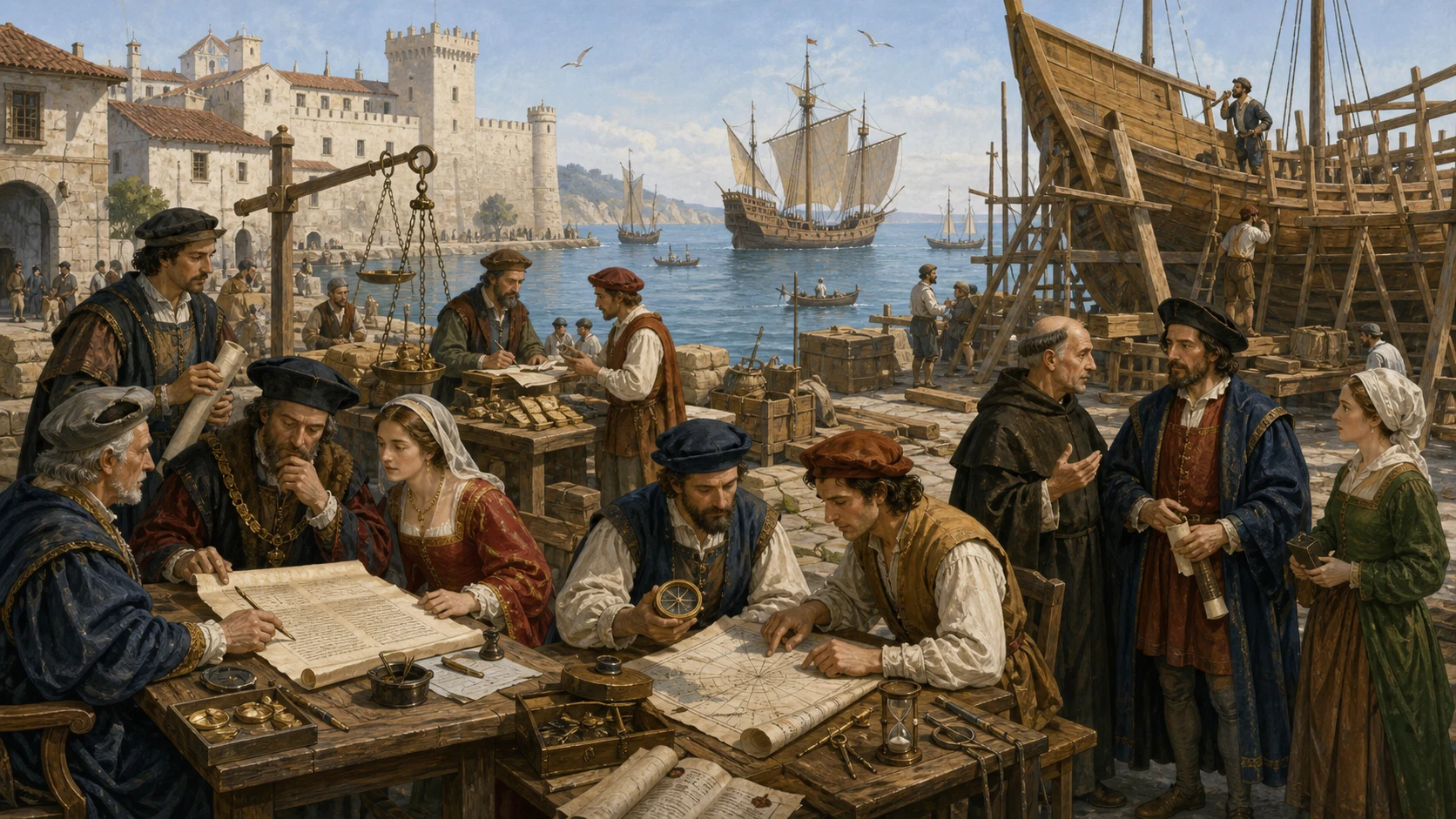
European monarchies and merchants sought direct access to Asian luxury goods, precious metals, new markets, taxable wealth, and strategic advantage over rivals. Iberian rulers also linked expansion to Christian mission and the political culture created by centuries of warfare on the peninsula. Royal charters and patronage converted these ambitions into expeditions by supplying legal authority, prestige, and resources.
No single invention caused Atlantic expansion. Mariners combined magnetic compasses, improved charts, astronomical instruments, ocean-going ship designs, and practical knowledge of winds and currents accumulated through Mediterranean and Atlantic travel. Commercial partnerships and credit distributed risk, while Portuguese voyages along Africa's coast provided experience in navigation, trade, plantation production, and the trafficking of enslaved Africans.
For most exam arguments, commercial and geopolitical incentives are the strongest primary causes because they explain why rulers and investors repeatedly financed expensive voyages. Technology is usually an enabling condition: it helps explain how sustained crossings became possible, but not why governments and merchants chose to undertake them. Religious goals were genuine and politically useful, yet their relative importance changed by expedition and empire.
Synthesis table 04
Trace Period 1 through linked causes, mechanisms, and effects
The same development can be an effect in one argument and a cause in another. For example, population collapse was an effect of epidemic disease, warfare, forced labor, hunger, and displacement. That collapse then became a cause of political disruption and intensified colonial demand for other laborers, including enslaved Africans. Naming the intermediate mechanism makes the chain historically defensible.
Use this matrix as an argument builder, not a memorization chart. Select the row that answers the exact prompt, add one or two pieces of specific evidence, and explain why that causal relationship was more significant than an alternative.
| Cause or process | Causal mechanism | Immediate effect | Longer-term effect | Best evidence or qualification |
|---|---|---|---|---|
| Commercial ambition, state rivalry, and Christian expansion | Monarchies granted charters, funded voyages, claimed territory, and rewarded extraction and conversion. | Regular crossings, reconnaissance, conquest, and permanent Spanish settlements followed. | European empires competed for American land, trade, labor, and strategic position. | Columbus's voyages and the Treaty of Tordesillas show sponsorship and rivalry; motives varied among rulers, merchants, and clergy. |
| Maritime knowledge, ship design, and investment | Better navigation and risk-sharing made repeated long-distance crossings more feasible. | People, animals, crops, pathogens, weapons, and information moved across the Atlantic more regularly. | A durable Atlantic network connected Europe, Africa, and the Americas. | Technology enabled expansion but did not supply the political or economic reason to sail. |
| Sustained biological exchange | Communities without prior exposure faced new pathogens; introduced plants and animals entered local ecologies. | Epidemic mortality, food-system disruption, new livestock, and new crops transformed daily life. | Demographic collapse weakened many communities while global diets, agriculture, and environments changed. | Disease was central, but warfare, forced labor, hunger, displacement, and repeated outbreaks intensified mortality. |
| Spanish conquest plus Indigenous alliances | Small Spanish forces used steel, horses, diplomacy, epidemic disruption, and large coalitions of Indigenous rivals. | The Mexica and Inca states fell and Spanish authorities claimed tribute, land, and labor. | New Spain and Peru became centers of imperial government, missions, mining, and social hierarchy. | Indigenous allies pursued their own goals; conquest was not a simple Europeans-versus-Natives struggle. |
| Colonial extraction and labor demand | Encomienda, tribute, repartimiento, slavery, and plantation or mining regimes redirected work and wealth. | Indigenous communities faced coercion, relocation, and production demands; enslaved Africans were forcibly transported. | American silver and plantation goods strengthened Atlantic commerce while hereditary racial slavery expanded. | Labor systems varied by region and changed under law, resistance, demographic conditions, and colonial needs. |
| Divergent worldviews and colonial encroachment | Conflicting ideas about land, religion, authority, family, and reciprocity shaped settlement and mission policies. | Misunderstanding, conversion pressure, diplomacy, selective adoption, and resistance followed. | New syncretic cultures and racialized hierarchies developed alongside continuing Indigenous sovereignty and conflict. | Neither Europeans nor Native Americans held one uniform worldview; name a nation, empire, or institution when possible. |
Unequal consequences 05
Disease produced the largest demographic shock, while colonial violence and ecological change magnified it
Afro-Eurasian diseases such as smallpox, measles, and influenza entered populations with no prior exposure to them. Repeated epidemics killed an enormous share of Indigenous people in many regions. Mortality disrupted families, agriculture, diplomacy, political succession, religious life, and the transmission of knowledge. These disruptions could make communities more vulnerable to conquest, tribute demands, relocation, and missionization.
Disease was the most significant direct cause of Indigenous demographic collapse, but it did not operate in isolation. Warfare, forced labor, food shortages, displacement, and colonial demands increased vulnerability and prevented recovery. The extent and timing also varied by region; communities beyond direct European settlement could encounter epidemics through Indigenous trade and travel networks before seeing Europeans themselves.
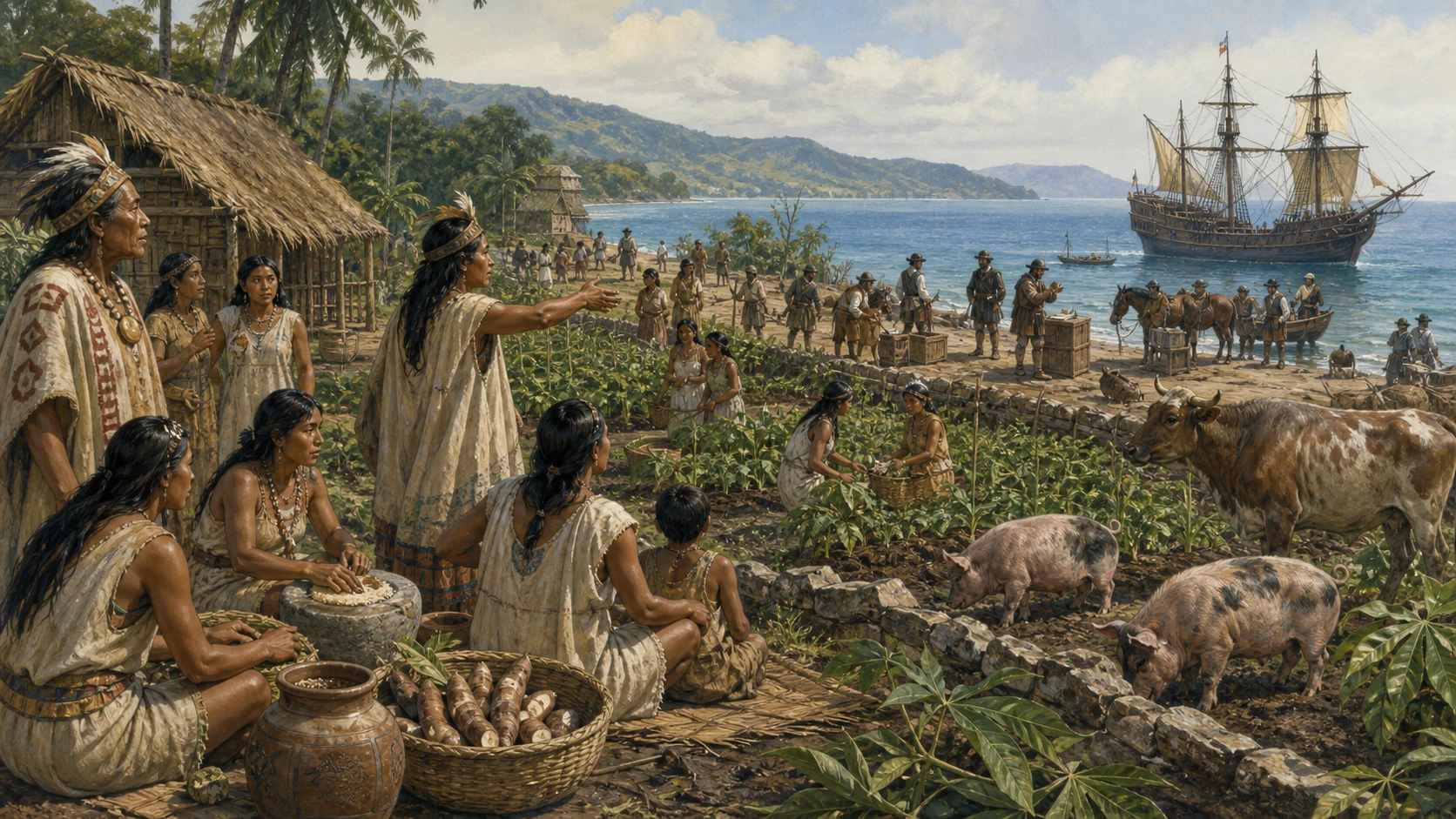
The Columbian Exchange also transformed environments. Horses expanded mobility and warfare in later North American societies; cattle and pigs damaged fields and competed for land; sugar encouraged plantation production; and American maize and potatoes supported population growth elsewhere. Environmental exchange was multidirectional, but control over land and labor made its human costs sharply unequal.
Atlantic transformation 06
Extraction connected an Atlantic economy to colonial government, coerced labor, and racial hierarchy
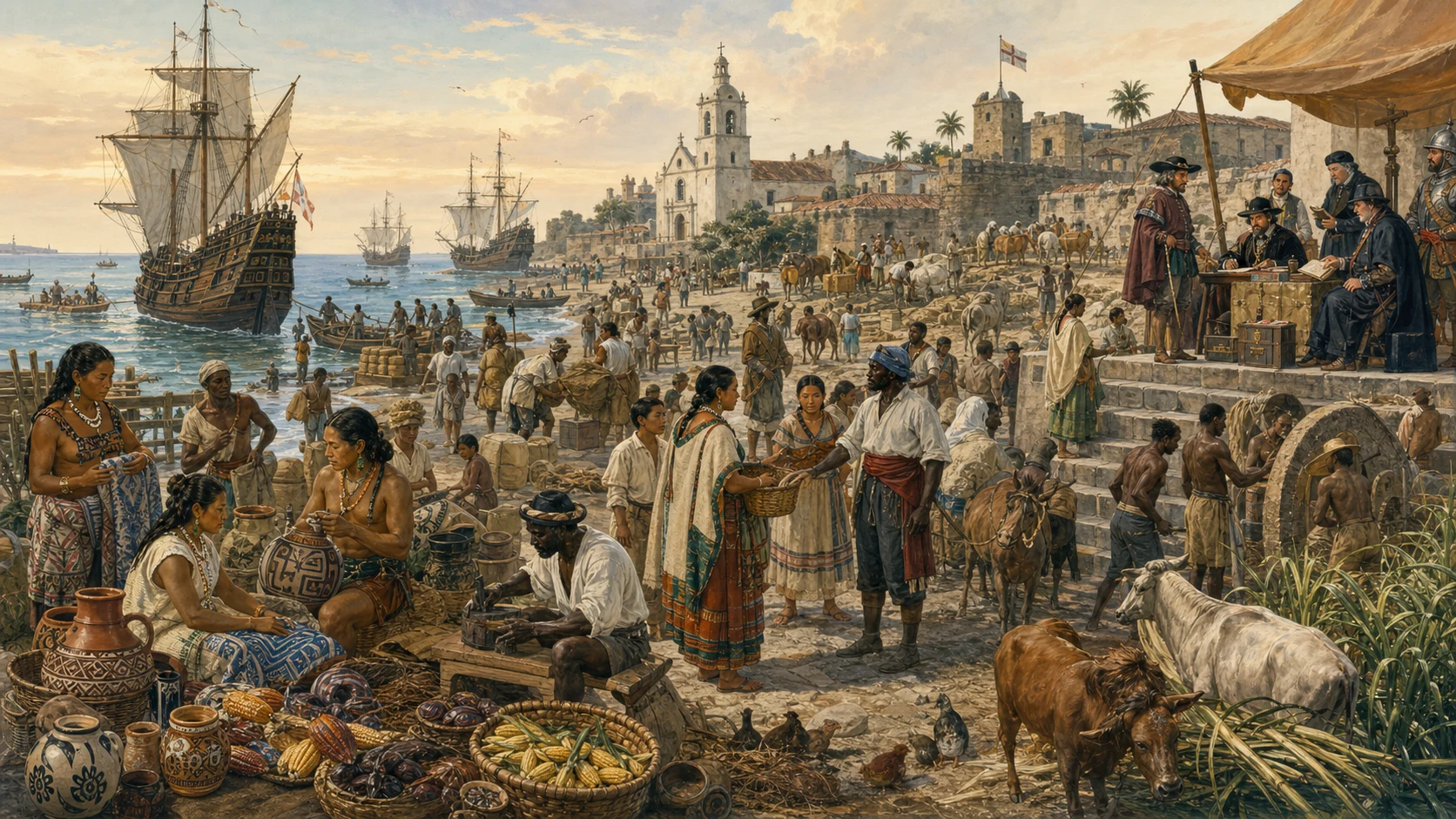
Spanish authorities built colonial government around claims to land, tribute, conversion, and labor. Encomienda rewarded colonists with claims to Indigenous tribute and labor; later repartimiento drafts and other local systems continued coercion. Silver mining, especially after the opening of Potosí in 1545, linked American extraction to European and Asian markets and gave the Crown both revenue and reason to defend its empire.
Population loss, plantation growth, existing Atlantic trafficking networks, and colonial demand contributed to the forced migration of Africans. Enslaved Africans worked in agriculture, mining, households, ports, ranching, and skilled trades. Africans were also sailors, soldiers, interpreters, craftspeople, family members, cultural creators, and resisters. Their presence cannot be reduced to a labor statistic.
Colonial societies developed ranked legal and social distinctions involving ancestry, birthplace, freedom, wealth, gender, occupation, and reputation. Europeans increasingly used religious, cultural, and racial arguments to justify unequal rule and hereditary bondage. Yet caste categories were never perfectly fixed, and royal reforms, Indigenous litigation, African resistance, frontier conditions, and local negotiation could alter how power operated.
Agency and contingency 07
Indigenous and African choices shaped outcomes without eliminating colonial coercion
Indigenous nations were not passive recipients of change. They traded selectively, formed and broke alliances, controlled information, relocated, petitioned, litigated, preserved ceremonies, entered missions strategically, fled labor demands, and fought colonial forces. Indigenous allies were essential to Spanish victories, but their cooperation reflected their own rivalries and objectives rather than agreement with every Spanish goal.
Free and enslaved Africans likewise created families, communities, religious practices, foodways, languages, and networks across the early Atlantic world. They negotiated where possible, used skilled knowledge, sought freedom, escaped, resisted work regimes, and formed autonomous settlements. Agency explains how people acted within constraints; it does not imply that they possessed equal power or freely chose the colonial systems confronting them.
Including agency improves causal reasoning because outcomes were contingent: alliances could fail, communities could relocate, reforms could be resisted, and local knowledge could redirect an expedition. Avoid a predetermined story in which European victory was inevitable. Explain the material advantages and epidemic disruption that mattered while also identifying the human decisions through which events unfolded.
Exam method 08
Rank causes or effects, defend the ranking, and qualify the argument
A defensible thesis answers the prompt with a line of reasoning rather than listing topics. One model is: ‘Although maritime technology enabled repeated crossings, commercial competition among European states was the more significant cause of sustained Atlantic voyages because it supplied financing, legal authority, and incentives for conquest and settlement.’ The ‘although’ clause acknowledges a credible alternative; the ‘because’ clause explains the ranking.
For effects, a model is: ‘The most consequential effect of transatlantic voyages from 1491 to 1607 was Indigenous demographic collapse, because epidemic mortality destabilized communities and made conquest and coerced labor easier; however, Indigenous alliances and resistance caused outcomes to vary by region.’ Evidence such as smallpox during the siege of Tenochtitlan, encomienda, Potosí, or St. Augustine must then be linked to the causal logic rather than merely named.
In an SAQ, give one precise answer, one specific example, and one sentence explaining the link. In an LEQ or DBQ, organize body paragraphs by ranked causes or categories of effects, maintain the same comparison criteria, and return to relative significance. A qualification should refine the claim—not cancel it—by showing variation, another cause, a limit, or a different timescale.
Claim
State the cause or effect you judge most significant and answer the exact dates and task in the prompt.
Evidence
Use named developments such as the Treaty of Tordesillas, Indigenous alliances in Mexico, smallpox, encomienda, Potosí, or St. Augustine.
Reasoning
Explain the causal mechanism and why the evidence supports your ranking.
Qualification
Acknowledge regional variation, another important factor, agency, contingency, or a difference between immediate and long-term effects.
High-yield review
Key developments
Sustained Atlantic voyages developed
State competition, commercial incentives, Christian expansion, investment, and accumulated maritime knowledge turned individual crossings into durable networks.
The Columbian Exchange reshaped populations and environments
Pathogens, crops, animals, people, and ideas moved among continents, producing unequal demographic shocks and enduring ecological change.
Conquest depended on multiple causes
Spanish military technology and tactics combined with epidemic disruption, Indigenous alliances, existing rivalries, and imperial leadership crises.
Extraction reorganized labor and wealth
Tribute, encomienda, repartimiento, mining, plantations, and slavery redirected Indigenous and African labor into an expanding Atlantic economy.
New hierarchies and cultures emerged
Colonial law and racialization created unequal status systems while sustained interaction also produced mixed communities, exchange, and syncretic practices.
Agency made outcomes contingent
Indigenous and African diplomacy, alliance, labor, adaptation, cultural preservation, flight, litigation, and resistance changed how colonial systems developed.
Chronological reasoning
Timeline — key moments
Diverse Indigenous worlds provide the context
Sovereign societies adapted to varied environments, maintained trade and diplomatic networks, and possessed distinct political, economic, and spiritual systems before sustained Atlantic contact.
Sustained transatlantic contact begins
Columbus's voyage under Spanish sponsorship initiated repeated crossings that connected Europe, Africa, and the Americas more permanently.
Permanent Spanish colonization expands
Columbus's second voyage carried settlers, clergy, livestock, crops, and supplies, accelerating ecological exchange, conquest, and demands for Indigenous tribute and labor.
Enslaved Africans recorded on Hispaniola
Early forced African migration joined Indigenous labor coercion within Spanish colonization and helped establish a growing transatlantic slave system.
Spanish–Indigenous coalition conquers Tenochtitlan
Cortés relied on thousands of Indigenous allies, existing political rivalries, siege warfare, and epidemic disruption to defeat the Mexica capital.
Spanish forces seize the Inca ruler and capital
Pizarro exploited civil war, political division, epidemic instability, alliance, surprise, and violence to extend Spanish claims into the Andes.
New Laws attempt to restrain colonial abuse
The Crown tried to limit Indigenous enslavement and encomienda inheritance, revealing both criticism of exploitation and royal efforts to control powerful colonists.
Potosí silver transforms imperial extraction
The discovery of vast silver deposits intensified coerced labor and tied the Americas more closely to European and Asian commercial networks.
St. Augustine becomes a lasting Spanish settlement
Spanish colonists, free and enslaved Africans, and neighboring Native peoples made Florida part of an imperial borderland shaped by labor, defense, diplomacy, and conflict.
Spanish settlement enters Pueblo homelands
Oñate's expedition imposed settlement, tribute, labor, and mission demands in New Mexico, illustrating both the reach and contested character of Spanish expansion by the end of Period 1.
Remember these
Vocabulary
- Causation
- Historical reasoning that explains why a development occurred, what it produced, and how causes or effects differed in importance and duration.
- Historical context
- The broader conditions and processes already operating around or before a development that help explain its occurrence and meaning.
- Primary cause
- The cause judged most significant according to stated criteria such as reach, intensity, duration, or necessity.
- Secondary cause
- A real contributing factor that was less influential, more limited, or dependent on another cause in the argument being made.
- Causal mechanism
- The process that explains how one condition, decision, or event produced a particular outcome.
- Immediate effect
- An outcome that appeared relatively soon after a cause, even if its scale or timing varied by place.
- Long-term effect
- A consequence that developed, persisted, or became more important over an extended period.
- Relative significance
- A reasoned judgment comparing the importance of causes or effects using clear historical criteria.
- Historical claim
- An evidence-based answer about the past that can be supported, challenged, or refined through reasoning.
- Defensible thesis
- A historically supportable answer that establishes a clear line of reasoning and responds directly to the prompt.
- Qualification
- A refinement that acknowledges a limit, variation, alternative factor, or exception without abandoning the main claim.
- Contingency
- The principle that outcomes depended on particular circumstances and choices and were not inevitable in advance.
- Columbian Exchange
- The post-1492 transfer of plants, animals, pathogens, people, technologies, and ideas among the Americas, Europe, and Africa.
- Demographic collapse
- The severe decline of Indigenous populations caused principally by repeated epidemics and intensified by warfare, forced labor, hunger, and displacement.
- Encomienda
- A Spanish Crown grant allowing a colonist to demand Indigenous tribute or labor while claiming obligations of protection and Christian instruction.
- Transatlantic slave trade
- The forced transportation and sale of enslaved Africans across the Atlantic within a developing system of hereditary racial bondage.
- Atlantic world
- The connected system of migration, commerce, empire, coerced labor, cultural exchange, and ecological transfer linking Europe, Africa, and the Americas.
- Indigenous agency
- The capacity of Native peoples to make strategic choices through diplomacy, alliance, trade, adaptation, migration, litigation, cultural preservation, and resistance.
Clear the confusion
Frequently asked questions
20 detailed answers to the questions students most often carry into Topic 1.7.
01What is the main learning objective of APUSH Topic 1.7?
You should be able to explain the effects of the development of transatlantic voyages from 1491 to 1607. A complete response identifies specific demographic, environmental, economic, social, political, or cultural effects and explains the mechanisms connecting sustained voyages to those outcomes. Topic 1.7 also expects you to synthesize evidence from the entire unit.
02What does causation mean in AP U.S. History?
Causation means explaining why a historical development occurred or what it produced. You must do more than place events in sequence. Identify a precise cause, explain the mechanism through which it changed conditions, support the relationship with evidence, and—when the prompt asks—evaluate its significance relative to another cause or effect.
03How is causation different from chronology or correlation?
Chronology tells you that A happened before B; correlation shows that A and B occurred together. Neither proves that A helped produce B. Causation requires a plausible historical mechanism supported by evidence. For example, voyages did not merely precede epidemic mortality: repeated crossings transported pathogens into populations without prior exposure, creating outbreaks that disrupted communities.
04How do I identify a causal mechanism?
Ask what the proposed cause actually did. Did it finance, enable, spread, remove, disrupt, reorganize, or intensify something? Then name the intermediate step. ‘Commercial competition encouraged monarchies to finance expeditions, which made repeated crossings and territorial claims possible’ contains a mechanism; ‘competition caused exploration’ is too compressed.
05What is the difference between a primary and a secondary cause?
A primary cause is the factor you judge most important according to criteria such as reach, intensity, duration, or necessity. A secondary cause still contributed but was more limited or depended on another factor. The ranking changes with the question: navigation may be essential to how voyages occurred, while commercial and geopolitical incentives better explain why they were repeatedly funded.
06How should I distinguish immediate and long-term effects?
Identify the timescale and then explain the transition. An epidemic can cause immediate mortality; repeated outbreaks can create long-term population decline, political disruption, labor shortages, and altered settlement patterns. Do not assume every effect appeared everywhere at once. Timing and intensity differed by community and region.
07What was the most important cause of sustained transatlantic voyages?
A strong argument identifies commercial ambition and interstate rivalry as the primary cause because rulers and investors expected wealth, strategic advantage, territory, and tax revenue. Christian expansion added genuine religious and political purpose. Maritime technology and knowledge were indispensable enabling conditions, but they do not by themselves explain the decision to finance repeated voyages.
08Did new technology cause European exploration by itself?
No. Ocean-going ships, compasses, charts, instruments, and knowledge of winds reduced risk and made crossings more feasible. These were enabling conditions. Political sponsorship, commercial opportunity, religious goals, accumulated Atlantic experience, and investment supplied the incentives and organization. Treating one invention as the cause ignores the broader system required for sustained voyages.
09What was the most significant effect of transatlantic voyages in Period 1?
Indigenous demographic collapse is the strongest choice because of its scale and its cascading effects on families, food production, political authority, military resistance, labor systems, and colonial expansion. A high-level answer then qualifies that judgment: disease was primary, but violence, forced labor, hunger, displacement, and repeated epidemics intensified mortality, with outcomes varying by region.
10Did disease alone cause Indigenous population decline?
Disease was the principal direct cause in many regions because Indigenous populations had no prior exposure to several Afro-Eurasian pathogens. It did not act alone. Warfare, forced labor, displacement, ecological disruption, malnutrition, and colonial demands increased vulnerability and interfered with recovery. Use ‘disease intensified by colonial conditions’ instead of a purely biological or deterministic explanation.
11Why do Indigenous alliances matter to the causation of Spanish conquest?
Spanish expeditions were small and depended on thousands of Indigenous allies who supplied warriors, food, intelligence, transportation, and knowledge. Those allies acted from their own rivalries and political goals. Their role shows that conquest resulted from specific coalitions, epidemic disruption, technology, leadership decisions, and existing conflicts—not automatic European superiority.
12Why did African slavery expand after Atlantic contact?
Expansion resulted from several reinforcing causes: colonial demand for labor, severe Indigenous population loss, plantation and mining growth, existing Portuguese trafficking networks, and laws that increasingly tied African ancestry to hereditary bondage. Africans were forced migrants but also skilled workers, sailors, soldiers, cultural creators, community builders, and resisters within the emerging Atlantic world.
13What economic effects did Atlantic voyages have?
Voyages redirected land, labor, and commodities into imperial networks. American silver, especially from Potosí, entered European and Asian trade; plantation crops generated profits; colonial markets increased shipping and investment; and coerced labor enriched colonists and monarchies. These gains were distributed unequally and depended on Indigenous dispossession and Indigenous and African labor.
14What social and political effects developed in the Americas?
Spanish colonies created governments, missions, tribute systems, towns, and legal hierarchies while weakening or reorganizing some Indigenous political networks. Mixed communities formed, and status increasingly reflected ancestry, birthplace, freedom, wealth, gender, and occupation. Native sovereignty continued, however, and colonial authority remained uneven, negotiated, and contested—especially on frontiers.
15What environmental effects should I know for Topic 1.7?
Introduced pigs and cattle could damage Indigenous fields and encourage land claims; horses eventually transformed mobility, trade, and warfare in parts of North America; European grains and sugar altered land use; and American maize and potatoes supported population growth abroad. Exchange moved both ways, but imperial control made costs and benefits unequal.
16How did Indigenous and African agency affect Period 1 outcomes?
Indigenous peoples formed alliances, controlled trade and information, relocated, negotiated, litigated, selectively adopted technologies, preserved culture, and resisted. Africans used skilled knowledge, formed families and communities, maintained and adapted beliefs, sought freedom, escaped, and resisted labor regimes. Agency changed outcomes without erasing the coercive conditions that limited available choices.
17How do I evaluate relative significance?
Choose explicit criteria. Reach asks how widely a factor operated; intensity asks how deeply it changed life; duration asks how long effects lasted; foundational importance asks whether later developments depended on it. Compare two factors using the same criteria, then explain why one mattered more. Do not simply label one ‘most important’ without showing the basis of the judgment.
18What is a strong thesis formula for a Period 1 causation prompt?
Use: ‘Although X contributed to the development, Y was more significant because mechanism A and mechanism B; however, Z caused the pattern to vary.’ Example: ‘Although navigation enabled Atlantic crossings, state-backed commercial rivalry mattered more because it financed repeated expeditions and territorial claims, while Indigenous alliances made the results regionally contingent.’
19How should I use evidence and qualification together?
Use evidence to prove the main chain and qualification to refine it. You might cite smallpox and Indigenous alliances in the fall of Tenochtitlan, then argue that disease was a major advantage but did not eliminate the need for diplomacy and coalition warfare. A qualification recognizes complexity; it should narrow or vary the claim, not reverse it.
20How can Topic 1.7 appear on an SAQ, DBQ, or LEQ?
An SAQ may ask for one cause, one effect, and an explanation of the connection. A DBQ may ask you to evaluate the effects of contact using maps, laws, missionary accounts, demographic evidence, or Indigenous perspectives. An LEQ may require ranking causes or effects. In every format, answer the date range, use specific evidence, explain mechanisms, and qualify broad claims.
Use the knowledge
AP exam connections
- 1
Separate motives from enabling conditions: commercial and geopolitical incentives explain why voyages were funded, while ships, navigation, knowledge, and capital explain how they became sustainable.
- 2
Turn chronology into causation by naming the intermediate mechanism between each piece of evidence and the claimed effect.
- 3
Distinguish immediate from long-term effects and evaluate significance through reach, intensity, duration, or foundational importance.
- 4
Use Indigenous and African agency to explain contingency and regional variation without minimizing colonial violence, forced migration, or unequal power.
- 5
Write a qualified thesis that ranks a cause or effect, acknowledges a credible alternative, and supports the judgment with specific Period 1 evidence.
Editorial trust
Sources and review
These notes are original OnlyPrepy content. The syllabus scope and historical framing were checked against the following authoritative sources on August 15, 2026.
- AP U.S. History Course and Exam Description, Effective Fall 2026College Board
- Europe Claims America: The Atlantic JoinedLibrary of Congress
- Colonial Settlement, 1600s–1763: OverviewLibrary of Congress
- Beginnings: African Immigration and RelocationLibrary of Congress
- Spanish Colonial CultureU.S. National Park Service